Skip to content
LITHOEN

Resource commodity

Copper (commodity)

Copper as a sought material rather than as a chemical element. The distinction matters: the element is in every crustal rock, and the commodity exists only where a system has concentrated it and left it recoverable.

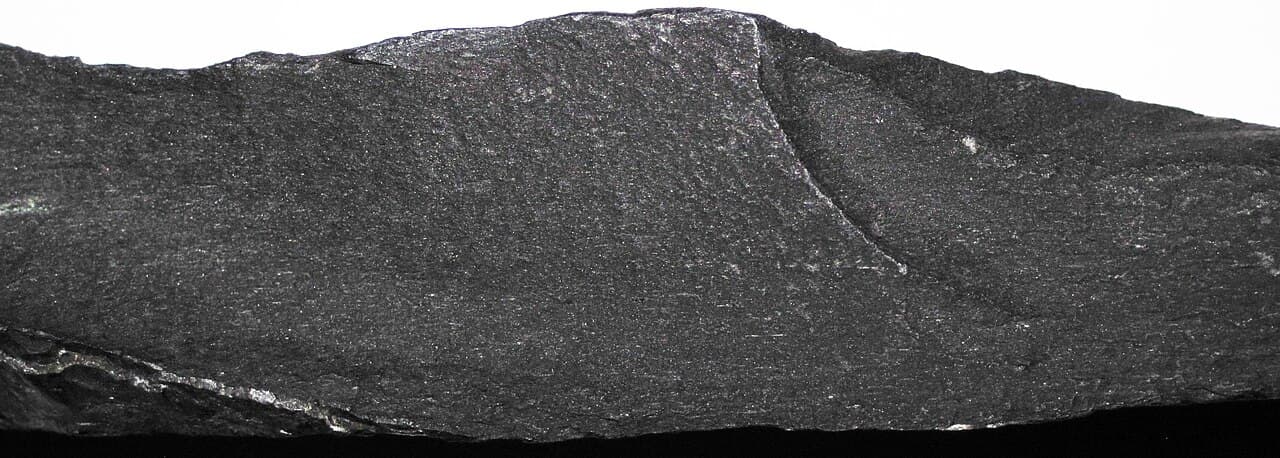
A long narrow slab of dark laminated shale, its bedding running the length of the sample.
The same Permian copper shale at Mansfeld in Germany, several hundred kilometres from Lubin. The Kupferschiefer horizon is thin and remarkably persistent, and this pairing is the point: one stratigraphic bed carries copper mineralisation across northern Europe. This sample is from Mansfeld itself, which Lithoen does not hold as a deposit record; the German deposits it does hold, Richelsdorf and Konrad, are separate bodies in the same bed and are not what this image shows. It illustrates how the compilation states stratigraphic position — a host bed with a unit beneath and a unit above — and not the host geology of any deposit in this corpus. Locality: Mansfeld, Saxony-Anhalt, Germany.

James St. John, CC BY 2.0 · CC-BY-2.0 · source · Derivative: Downscaled to 1200 px wide by the Wikimedia thumbnail service; no cropping, no colour or content alteration.

Classification

commodity class
metal

How this record is known

1
Settled consensus
Cited as the accepted position of the discipline.

1 of 1 claims on this page cite at least one registered source. Counts describe how each statement is known, not how likely it is to be true.

What Lithoen records

Each claim states how it is known and cites its evidence.

EstablishedGermany: no mine production, 630 kt refined (2024e). Poland: 410 kt mined, 590 kt refined (2024e).

Reported for this deposit

A property of a dataset or model, shown here for context — not an observation about this record.

The U.S. Geological Survey reports Germany as producing NO copper from mines in either 2023 or 2024 while refining 609 and an estimated 630 thousand tonnes of copper content in those years, and Poland as mining 395 and an estimated 410 thousand tonnes while refining 592 and an estimated 590. In one country the refineries run on no domestic mine output at all; in the other they process more copper than the country's mines produce. Where a refinery stands says nothing about where its feed comes from.

  • assertion basis: SOURCE_REPORTED
  • generality: DATASET_PROPERTY
  • definition basis: Two separate columns of the survey's world table — mine production and refinery production — in thousand metric tons of copper content.
  • temporal basis: 2023 reported and 2024 estimated, as published in January 2025.
  • assumption: Refinery production is not evidence of any particular feed source. This says that domestic mine output cannot account for the refined output, and says nothing about which countries the feed actually came from.

Evidence support: Supported by the cited evidence one source

Evidence: Survey 2025 Primary authority
In the knowledge graph

Figures

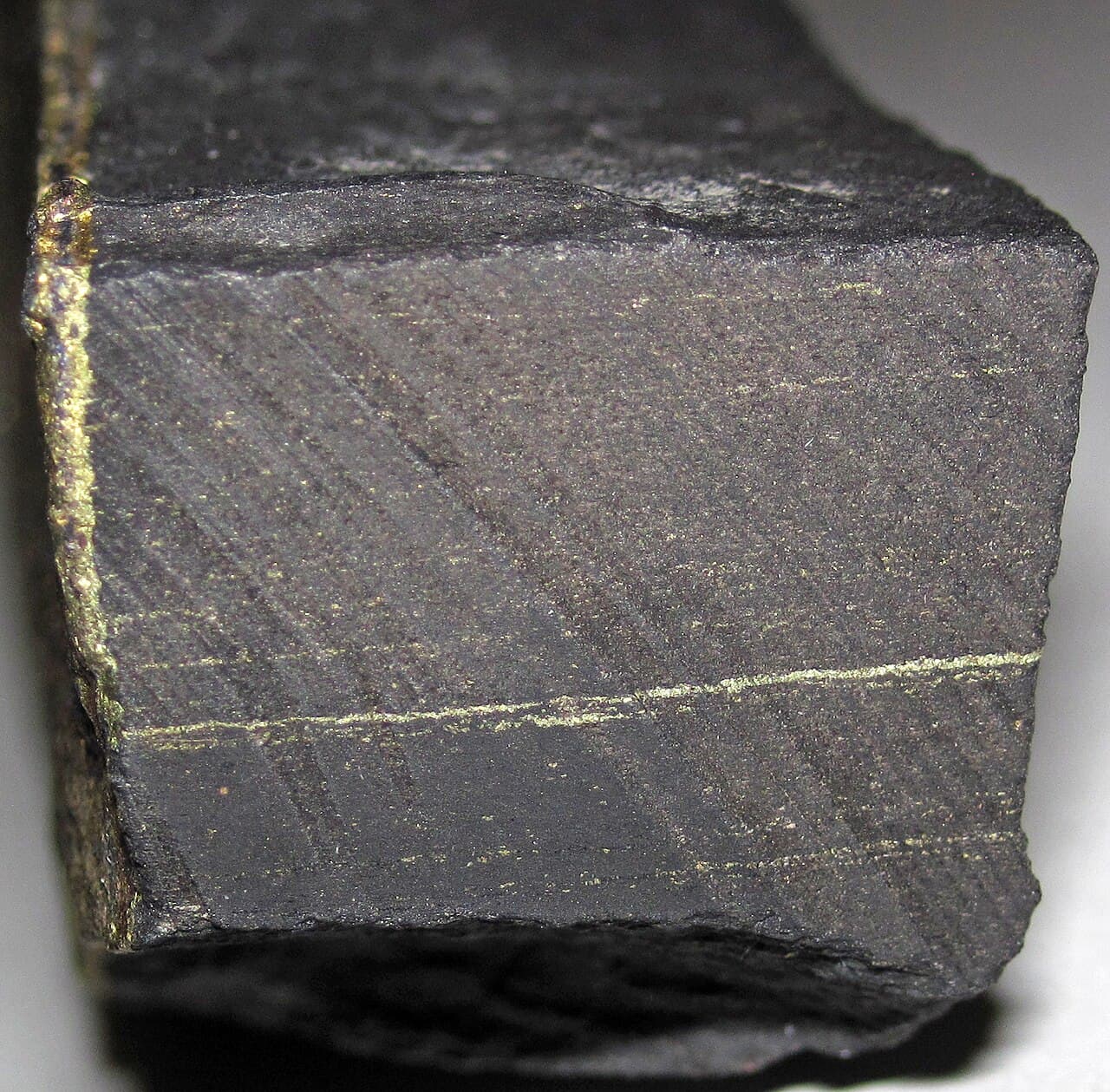
A sawn slab of dark grey-black shale with fine pale metallic streaks running parallel across its face.
A cut face of the Kupferschiefer from the Rudna mine at Lubin — the deposit this corpus holds as a sediment-hosted copper deposit. The pale streaks running across the front face are sulfide-rich laminations within a dark, organic-rich, calcareous shale less than a metre thick. What the image shows is the ore itself: finely disseminated sulfides in a black shale, which is what "sediment-hosted" means for this class. It shows no grade, no thickness at any particular point, and nothing about the extent of the deposit. Locality: Rudna mine, north of Lubin, southwestern Poland.

James St. John, CC BY 2.0 · CC-BY-2.0 · source · Derivative: Downscaled to 1200 px wide by the Wikimedia thumbnail service; no cropping, no colour or content alteration.

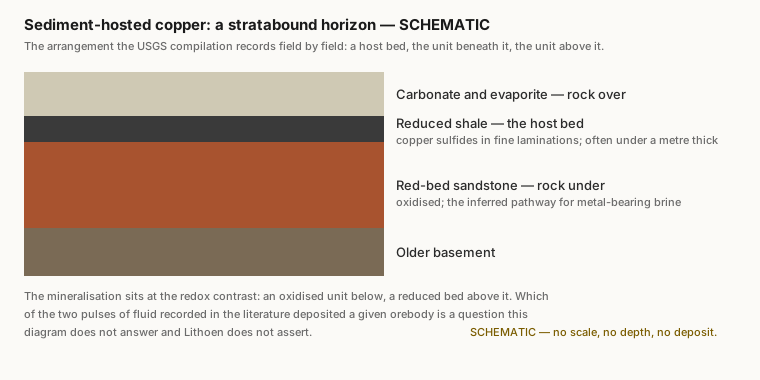
A stratigraphic column with a thin dark bed labelled as the host between a red sandstone below and carbonate above.
SchematicA schematic showing where sediment-hosted copper mineralisation sits: a thin reduced bed between an oxidised unit below and a sealing unit above. The arrangement is drawn from the three fields the USGS sediment-hosted copper compilation records for every row — the host rock, the rock under and the rock over — which is how that dataset states a deposit’s stratigraphic position. No scale, no depth, and no particular deposit.

Original Lithoen diagram · LITHOEN-ORIGINAL

Record last updated 2026-09-07. Corrections follow the published corrections policy; superseded claims are retained, never silently edited.