Skip to content
LITHOEN

Mineral system

Volcanogenic massive sulfide system

Also known as VMS system, Volcanic-hosted massive sulfide system

A seafloor hydrothermal system in which seawater is drawn into hot volcanic crust, evolves chemically by reacting with it, and discharges at the sea floor where abrupt cooling precipitates massive sulfide. Its driver is magmatic heat; its fluid is the ocean.

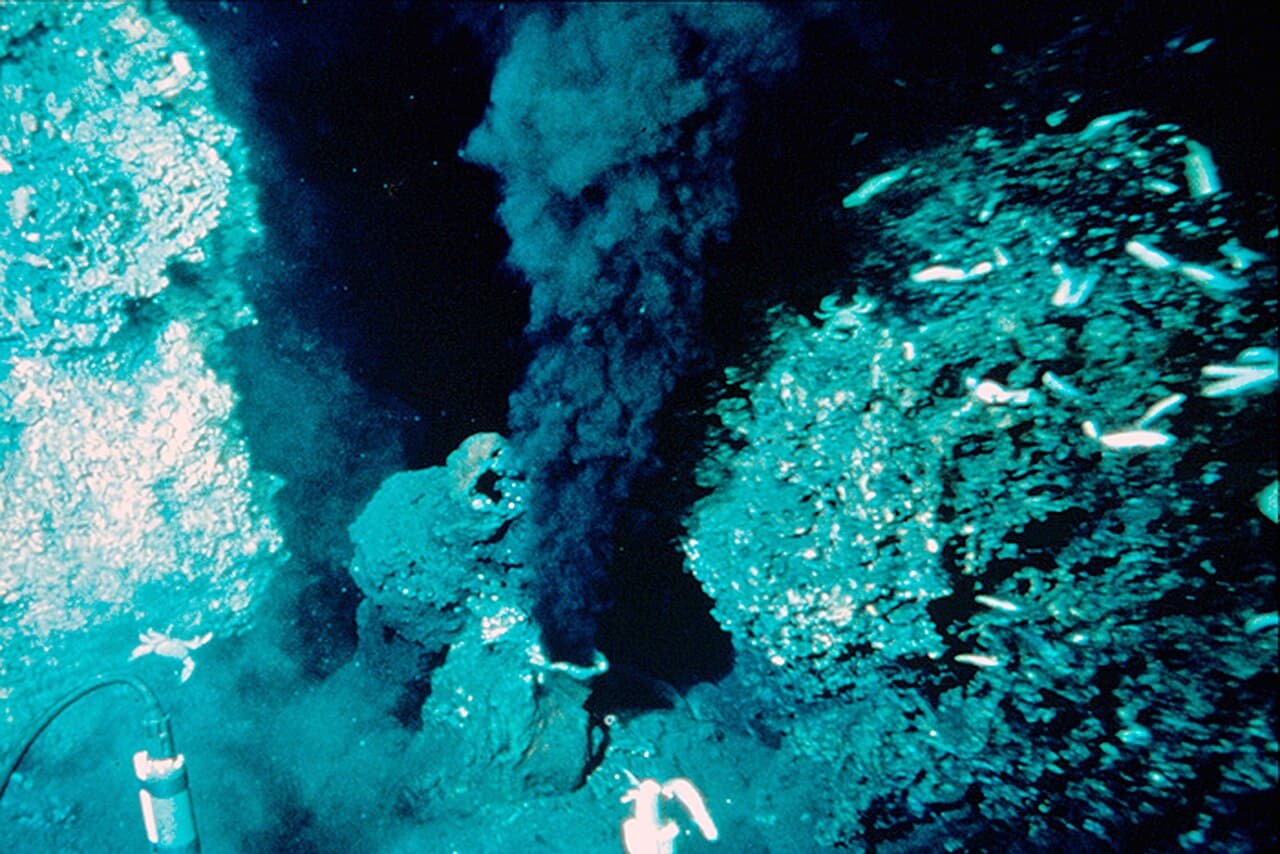
A dark plume issuing from a mineral chimney on the seafloor, lit by a submersible.
A high-temperature black smoker vent on the seafloor. The USGS occurrence model describes these vents, discharging at about 350 °C and first found on the East Pacific Rise in 1979, as the modern analogue for the volcanogenic massive sulfide deposits Lithoen holds. The analogy runs from the living system to the ancient one and is an interpretation, not an observation of any deposit in this corpus. Locality: Mid-ocean ridge seafloor.

W.R. Normark, Dudley Foster — public domain (U.S. Geological Survey) · PD-USGov · source · Derivative: Downscaled to 1200 px wide by the Wikimedia thumbnail service; no cropping, no colour or content alteration.

Classification

system class
seafloorHydrothermal
model provenance
publishedModel

System architecture

The chain from source to what may be observed. A limb is shown only where Lithoen has recorded it from a source; nothing here identifies a place, ranks ground or implies that a deposit exists.

  1. Source

    Where the system draws its components from. Each edge names the component it refers to; source differs between systems and is never generalised.

    • Oceanic crustestablished

      component
      Metals, leached from the volcanic pile as convecting seawater reacts with it along the flow path.
    • Leachingestablished

      component
      Metals, released from the volcanic pile into convecting seawater along the flow path.
    • Magmatic-hydrothermal fluidinferred

      component
      Magmatic water and volatiles, including sulfur species, as a possible additional contribution.
      precisionNote
      The model identifies this as potentially important, not as demonstrated; the edge is inferred and deliberately not established.
    • Seawaterestablished

      component
      The mineralising fluid itself, and the sulfate sulfur it carries.
      method
      Chemical and isotopic studies of fluid compositions in modern and ancient deposits.
  2. Transport

    What moves the components, and under what conditions. What a medium can carry depends on temperature, pressure, salinity and redox state, so every edge states the conditions it holds under.

    • Evolved seawaterestablished

      conditions
      Convecting seawater progressively modified by reaction with host rocks, reaching up to about 400 degrees Celsius in the upflow zone.
  3. Pathway and focusing

    What concentrated the flow. The presence of a structure is never on its own evidence that it focused anything, so each edge states the basis for the claim.

    • Hydrothermal convectionestablished

      method
      Laboratory experiments on basalt–seawater reaction, followed by direct discovery of active vents on ridges, arcs and back-arc centres.
    • Water–rock reactionestablished

      method
      Chemical and isotopic study of fluid compositions, which record the reaction path.
  4. Deposition

    Why the components stopped moving. A system may use more than one mechanism, and different mechanisms leave different signatures.

  5. Minerals, in their role here

    Mineral role is a property of a mineral in a system, not of the mineral. The same species is an ore mineral in one system and gangue in another.

    • Chalcopyriteinferred

      role
      ore mineral
      precisionNote
      Copper is named as a principal product of these deposits; chalcopyrite is inferred as its carrier and is not named in the retrieved passage.
    • Pyriteinferred

      role
      gangue
      precisionNote
      Massive sulfide is dominantly iron sulfide; the role is inferred from the deposit description rather than stated in the retrieved passage. In systems where iron itself is sought, the same mineral would not be gangue.
  6. Modification and preservation

    What happened after the system finished. Formation is not preservation, and what is observed today is the sum of both.

    • Metamorphisminferred

      precisionNote
      Ancient VMS deposits are preserved in deformed and metamorphosed terranes, so what is observed is generally an overprinted system. The cited evidence establishes the preservation problem rather than metamorphic overprinting specifically.
    • Oxidationestablished

      precisionNote
      Sulfides on the sea floor oxidise rapidly; this is the process the preservation mechanisms have to defeat.
  7. Commodity association

    A geological association only: a commodity characteristically won from this class of system where one is developed and preserved. No statement about any occurrence, and none about value.

  8. Tectonic and geological context

    The settings in which this system has been DOCUMENTED. Tectonic context is a necessary or common component of some models; it is not proof that mineralisation is present anywhere. Every entry states what else the setting contains.

    • Subductionestablished

      What else the setting contains
      Oceanic and continental-margin arcs and their back-arc basins span every ocean margin with a subduction zone behind it.
      precisionNote
      A documented context, not a prediction. The setting is vastly more extensive than the systems found in it, and this edge asserts only that sources place the system here.
    • Seafloor spreadingestablished

      What else the setting contains
      The mid-ocean ridge system is tens of thousands of kilometres long and hydrothermally active along much of it; nearly all of that activity leaves no preserved accumulation.
      precisionNote
      A documented context, not a prediction. The setting is vastly more extensive than the systems found in it, and this edge asserts only that sources place the system here.
  9. Observable expressions

    Features commonly associated with this system — and, for each, what else produces the same observation. None of these demonstrates that a system operated anywhere, and Lithoen ranks nothing.

    • Global mid-ocean ridge systeminferred

      What else produces this
      Hydrothermal venting occurs along most of the ridge system, and the overwhelming majority of vent sites host no accumulation of the size preserved as an ancient deposit. A ridge setting is a necessary background, not an indication of anything.
      assertionBasis
      MODEL_INHERITED_CONTEXT
      definitionBasis
      Black smoker vents on the East Pacific Rise are described as the modern analogue for the class of system. The indication runs from the class to the ridge, and marks where such systems have been found rather than what this ridge contains.

How this record is known

12
Settled consensus
Cited as the accepted position of the discipline.
1
Interpretation
Reached by reasoning from evidence, or produced by a named model.

13 of 13 claims on this page cite at least one registered source. Counts describe how each statement is known, not how likely it is to be true.

What Lithoen records

Each claim states how it is known and cites its evidence.

EstablishedAbsence from a compilation is a fact about the compilation.

General principle, shown here for context — not an observation about this record.

A deposit missing from a compilation is missing from that compilation. The USGS volcanogenic massive sulfide database states plainly that "it was not our intent to include every known deposit in the world", and that it excluded bodies whose metamorphic protolith was uncertain or which other investigators classed as sedimentary exhalative. Absence from it is therefore not evidence that a deposit does not exist, and not even evidence that a known deposit is not of this class.

  • generality: GENERAL_PRINCIPLE
  • precision note: Lithoen holds 1,090 rows from this compilation and publishes a curated subset of them. Neither number bounds the world.

Evidence support: Supported by the cited evidence one source

Evidence: D.L. 2009 Primary authority

EstablishedPreservation requires its own mechanism; formation does not guarantee survival.

Forming mineralisation and keeping it are different problems. Sulfides on the sea floor oxidise rapidly, and the preservation of ancient VMS deposits has been attributed to anoxic bottom waters, capping lava flows, or chemical precipitates of silica or sulfate that isolate the deposit from oxidising water.

Evidence support: Supported by the cited evidence one source

Evidence: III 2012 Primary authority

EstablishedArchean settings cannot be assigned confidently, because Archean tectonics is contested.

Deposits in Proterozoic and Phanerozoic sequences can generally be assigned to specific plate tectonic regimes, but the assignment of deposits in Archean terranes is less certain, because the role of conventional plate tectonic systems in early Earth history continues to be debated.

  • precision note: A limit on the whole Phase 4 project: tectonic context can only be assigned where a tectonic framework applies, and for the first half of Earth history that framework is itself in question.

Evidence support: Supported by the cited evidence one source

Evidence: III 2012 Primary authority

Established350 degC

High-temperature black smoker vents discharge at about 350 degrees Celsius; first found on the East Pacific Rise in 1979, they are most common on intermediate- to fast-spreading mid-ocean ridges, and studies of them form much of the basis for current models of VMS-forming systems.

  • method: Direct measurement at active seafloor vents, compiled by the USGS occurrence model.
  • system context: Modern high-temperature black smoker vents, the observable analogue for the ancient systems.
  • precision note: This is a measurement of a modern vent, not of any ancient deposit; the report notes that important questions about the formation and evolution of these vents remain.
  • precision note: Epistemic status corrected in Phase 7 from MEASURED to ESTABLISHED. The figure is the temperature the USGS occurrence model gives for black smoker vents as a class of feature — "at about 350 °C" — not a measurement the model reports making, and the subject of this claim is the system class rather than any vent. The value and the wording are unchanged; only the account of how it is known was wrong.

Evidence support: Supported by the cited evidence one source

Evidence: III 2012 Primary authority

EstablishedMagma-driven convection of seawater through the crust, evolving in composition along the flow path.

Seawater circulation through and reaction with ocean crust, driven by convective heating from subseafloor magma chambers, produces the ore-depositing fluids; the resulting compositionally evolved seawater reaches temperatures of up to about 400 degrees Celsius in the upflow zone and at the vent site.

  • conditions: Upflow-zone and vent-site temperatures up to about 400 degrees Celsius.
  • component: Water, metals and sulfur leached from the volcanic pile.

Evidence support: Supported by the cited evidence one source

Evidence: III 2012 Primary authority

EstablishedSulfide accumulation at or near the sea floor where circulating hydrothermal fluid discharges.

Volcanogenic massive sulfide deposits, also called volcanic-hosted, volcanic-associated or seafloor massive sulfide deposits, form at or near the sea floor where circulating hydrothermal fluids discharge, and are important sources of copper, zinc, lead, gold and silver.

Evidence support: Supported by the cited evidence one source

Evidence: III 2012 Primary authority

EstablishedCooling on mixing with cold seawater at the sea floor.

Cooling at the sea floor is regarded as the principal cause of sulfide precipitation in VMS systems, and wall-rock alteration is considered largely less significant to ore precipitation.

  • conditions: Discharge of hot fluid into cold ambient seawater at or just below the sea floor.

Evidence support: Supported by the cited evidence one source

Evidence: III 2012 Primary authority

EstablishedSeawater, evolved by reaction with the rocks it passes through, is the dominant mineralising fluid.

The vast majority of chemical and isotopic studies of fluid compositions in modern and ancient VMS deposits indicate that seawater, or evolved seawater, is the dominant mineralising fluid.

  • component: The mineralising fluid.
  • method: Chemical and isotopic studies of fluid compositions in modern and ancient deposits.

Evidence support: Supported by the cited evidence one source

Evidence: III 2012 Primary authority

Established400 degC

Fluids in the upflow zone and at the vent site of VMS systems reach temperatures of up to about 400 degrees Celsius.

  • method: Compiled by the USGS occurrence model from chemical and isotopic studies of fluid compositions in modern and ancient systems.
  • system context: Upflow zone and vent site of seafloor hydrothermal systems.
  • precision note: An upper value for the upflow zone, not a temperature that characterises the whole system.

Evidence support: Supported by the cited evidence one source

Evidence: III 2012 Primary authority

InferredA magmatic volatile contribution is possible alongside the dominant seawater component.

Magmatic water and related volatiles are identified as other potentially important contributors to ore transport in VMS systems; magmatic gases are typically about 90 mole percent water with 5 to 10 mole percent carbon dioxide and 1 to 2 mole percent sulfur species.

  • component: Water and volatiles, including sulfur species.
  • precision note: The report states this as a potential contribution, not a demonstrated one in any particular system, so Lithoen records it as inferred rather than established.

Evidence support: Supported by the cited evidence one source

Evidence: III 2012 Primary authority

EstablishedUSGS Volcanogenic Massive Sulfide Occurrence Model (SIR 2010–5070–C), Shanks and Thurston, eds., 2012.

This record represents the USGS Volcanogenic Massive Sulfide Occurrence Model, chapter C of Mineral Deposit Models for Resource Assessment, published in 2012. Lithoen represents that model and does not extend it.

  • model: USGS Volcanogenic Massive Sulfide Occurrence Model, Scientific Investigations Report 2010–5070–C.

Evidence support: Supported by the cited evidence one source

Evidence: III 2012 Primary authority

EstablishedAnoxic bottom water, capping lavas, or silica or sulfate caps.

Because sulfides on the sea floor oxidise rapidly, the survival of ancient VMS deposits has been attributed to anoxic or sulfidic bottom waters, to capping lava flows, or to chemical precipitates of silica or sulfate that cap the deposit and isolate it from oxidising bottom water.

  • precision note: These are proposed mechanisms in the report’s own framing; which operated in any given deposit is a separate question.

Evidence support: Supported by the cited evidence one source

Evidence: III 2012 Primary authority

EstablishedMarine extensional and arc settings where magmatic heat drives seawater circulation.

Volcanogenic massive sulfide deposits form in marine settings where magmatism, seismicity and high-temperature venting coincide: oceanic spreading ridges, oceanic and continental-margin volcanic arcs, related back-arc basins, and extensional environments in post-accretion or successor-arc settings such as rifted continental margins and strike-slip basins.

  • non uniqueness: The global mid-ocean ridge system alone is some tens of thousands of kilometres long and hydrothermally active along much of it. The setting is nearly ubiquitous in the ocean basins.

Evidence support: Supported by the cited evidence one source

Evidence: III 2012 Primary authority

In the knowledge graph

  • Volcanogenic massive sulfide system is a model interpreted for Ashele
  • Volcanogenic massive sulfide system is a model interpreted for Beatson
  • Volcanogenic massive sulfide system is a model interpreted for Bjurliden
  • Volcanogenic massive sulfide system is a model interpreted for Ellamar
  • Volcanogenic massive sulfide system is a model interpreted for Estaçao
  • Volcanogenic massive sulfide system is a model interpreted for Gacun
  • Volcanogenic massive sulfide system is a model interpreted for Khandiza
  • Volcanogenic massive sulfide system is a model interpreted for Kosaka (Uchinotai-Uwamuki)
  • Volcanogenic massive sulfide system is a model interpreted for Madneuli
  • Volcanogenic massive sulfide system is a model interpreted for Maleevskoe
  • Volcanogenic massive sulfide system is a model interpreted for Neves-Corvo
  • Volcanogenic massive sulfide system is a model interpreted for Novo-Berezovskoe
  • Volcanogenic massive sulfide system is a model interpreted for Ozernoe
  • Volcanogenic massive sulfide system is a model interpreted for Ridder-Sokol’noe
  • Volcanogenic massive sulfide system is a model interpreted for Rio Tinto
  • Volcanogenic massive sulfide system is a model interpreted for Tarnyerskoe
  • Volcanogenic massive sulfide system is a model interpreted for Tashiro
  • Volcanogenic massive sulfide system is a model interpreted for Vihanti
  • Volcanogenic massive sulfide system is associated with the commodity Gold (commodity)
  • Volcanogenic massive sulfide system is associated with the commodity Copper (commodity)
  • Volcanogenic massive sulfide system is associated with the commodity Lead (commodity)
  • Volcanogenic massive sulfide system is associated with the commodity Zinc (commodity)
  • Volcanogenic massive sulfide system is documented in the tectonic context Subduction
  • Volcanogenic massive sulfide system is documented in the tectonic context Seafloor spreading
  • Volcanogenic massive sulfide system deposits by Cooling
  • Volcanogenic massive sulfide system is focused by Hydrothermal convection
  • Volcanogenic massive sulfide system is focused by Water–rock reaction
  • Volcanogenic massive sulfide system may be indicated by Global mid-ocean ridge system
  • Volcanogenic massive sulfide system involves Chalcopyrite
  • Volcanogenic massive sulfide system involves Pyrite
  • Volcanogenic massive sulfide system is modified by Metamorphism
  • Volcanogenic massive sulfide system is modified by Oxidation
  • Volcanogenic massive sulfide system draws components from Oceanic crust
  • Volcanogenic massive sulfide system draws components from Leaching
  • Volcanogenic massive sulfide system draws components from Magmatic-hydrothermal fluid
  • Volcanogenic massive sulfide system draws components from Seawater
  • Volcanogenic massive sulfide system transports components in Evolved seawater
  • Volcanogenic massive sulfide system is a model interpreted for Vuonos
  • Volcanogenic massive sulfide system is a model interpreted for Whim Creek
  • Volcanogenic massive sulfide system is a model interpreted for Xiaorequanzi
  • Volcanogenic massive sulfide system is a model interpreted for Yokota (Motoyama-Hama)
  • Volcanogenic massive sulfide system is a model interpreted for Zolotushinskoe

Figures

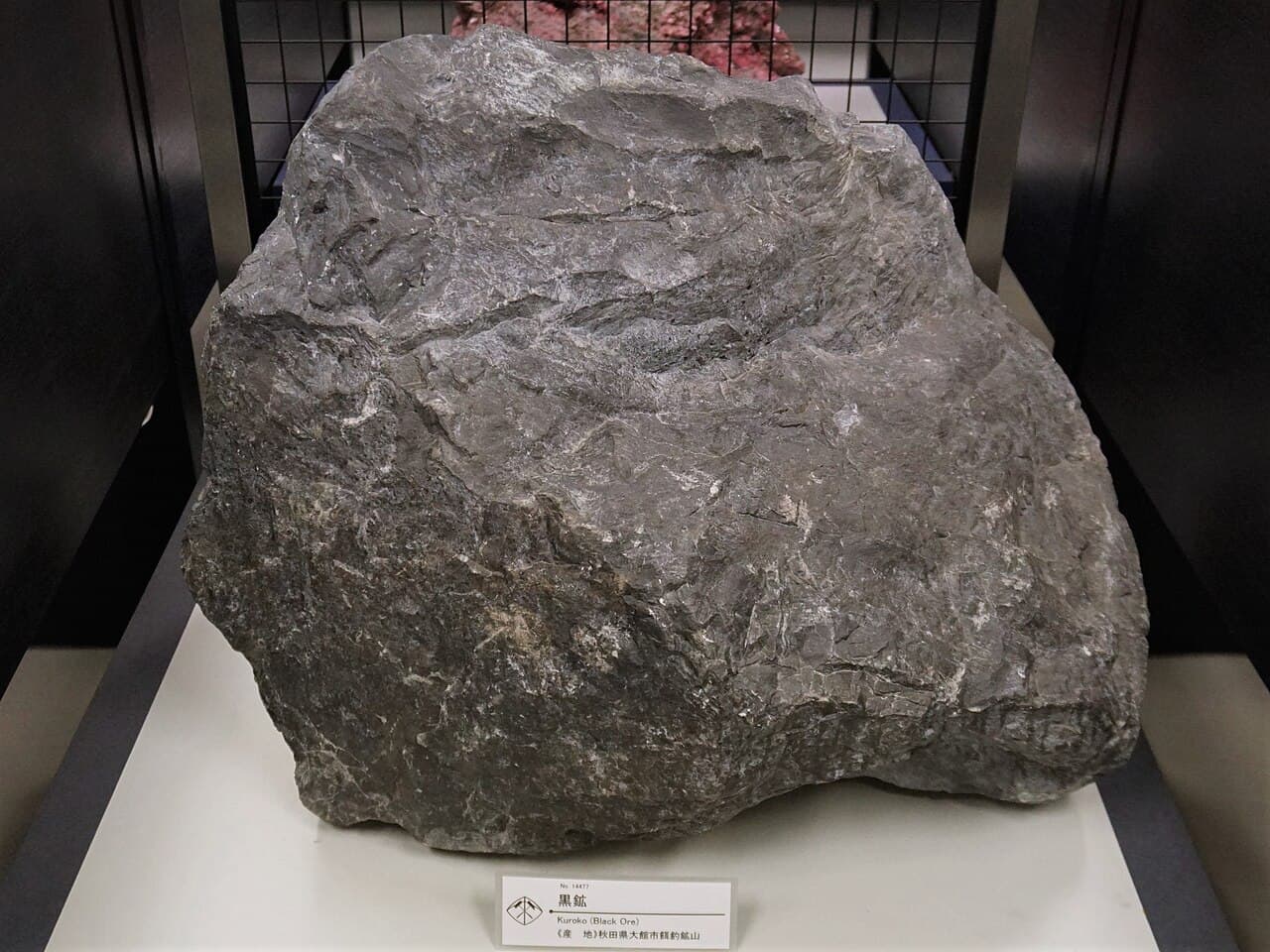
A dark, dense, fine-grained ore specimen in a museum display case.
Kuroko — "black ore" — the sphalerite-galena-barite ore that gave the Japanese volcanogenic massive sulfide deposits their name, displayed at the Mining Museum of Akita University. The specimen is labelled by ore type and not by deposit, so it shows what this class of ore looks like and not what any deposit in this corpus contains. The USGS compilation gathers the deposits formerly called kuroko, Cyprus and Besshi into the single volcanogenic massive sulfide class, which is why Lithoen carries one system rather than three. Locality: Mining Museum of Akita University, Akita, Japan.

掬茶, CC BY SA 4.0 · CC-BY-SA-4.0 · source · Derivative: Downscaled to 1200 px wide by the Wikimedia thumbnail service; no cropping, no colour or content alteration.

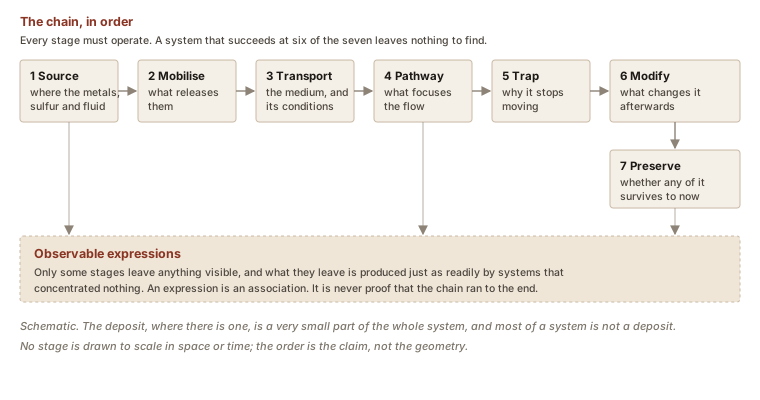
A schematic left-to-right chain of seven linked stages above a separate dashed band labelled observable expressions, with arrows running down from three of the stages into that band.
SchematicThe seven stages Lithoen records for every system: source, mobilisation, transport, pathway, trap, modification, preservation — with the observable expressions drawn as a separate band beneath, because only some stages leave anything to see. The order is the claim; nothing here is to scale in space or time, and the deposit, where there is one, is a very small part of the whole.

Original Lithoen diagram · LITHOEN-ORIGINAL

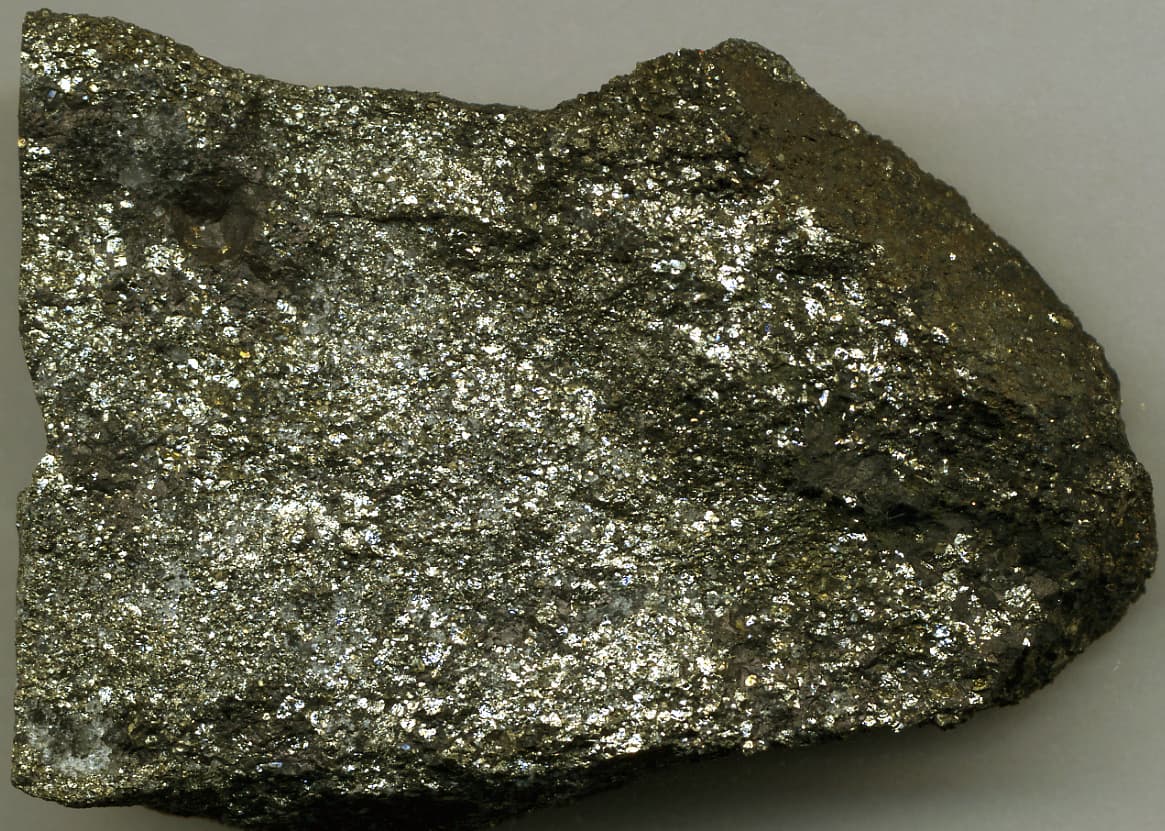
Cut slab of dense, metallic, brassy to steel-grey massive sulfide with a fine granular texture.
Massive sulfide from a Paleoproterozoic volcanogenic deposit. The source names the Flambeau mine in Wisconsin as the locality; Lithoen holds a Flambeau record but has not published it, so this image is not offered as evidence about that deposit. Sulfide of this kind accumulated at the sea floor where hot fluid met cold seawater; that it can be photographed at all means it escaped the rapid oxidation that removes most seafloor sulfide, and the mechanism that protected it is a separate question from the one that formed it. Locality: Flambeau Mine, northwestern Wisconsin, United States, as stated by the source.

James St. John, CC BY 2.0 · CC-BY-2.0 · source · Derivative: Downscaled to 1200 px wide by the Wikimedia thumbnail service; no cropping, no colour or content alteration.

Record last updated 2026-09-07. Corrections follow the published corrections policy; superseded claims are retained, never silently edited.