Skip to content
LITHOEN

Mineral system

Magmatic nickel-copper-PGE sulfide system

Also known as Magmatic Ni-Cu-PGE system

A wholly magmatic system in which a sulfide liquid separates from a silicate magma, scavenges chalcophile metals from it, and accumulates. There is no hydrothermal fluid and no aqueous transport: the concentrating agent is an immiscible liquid.

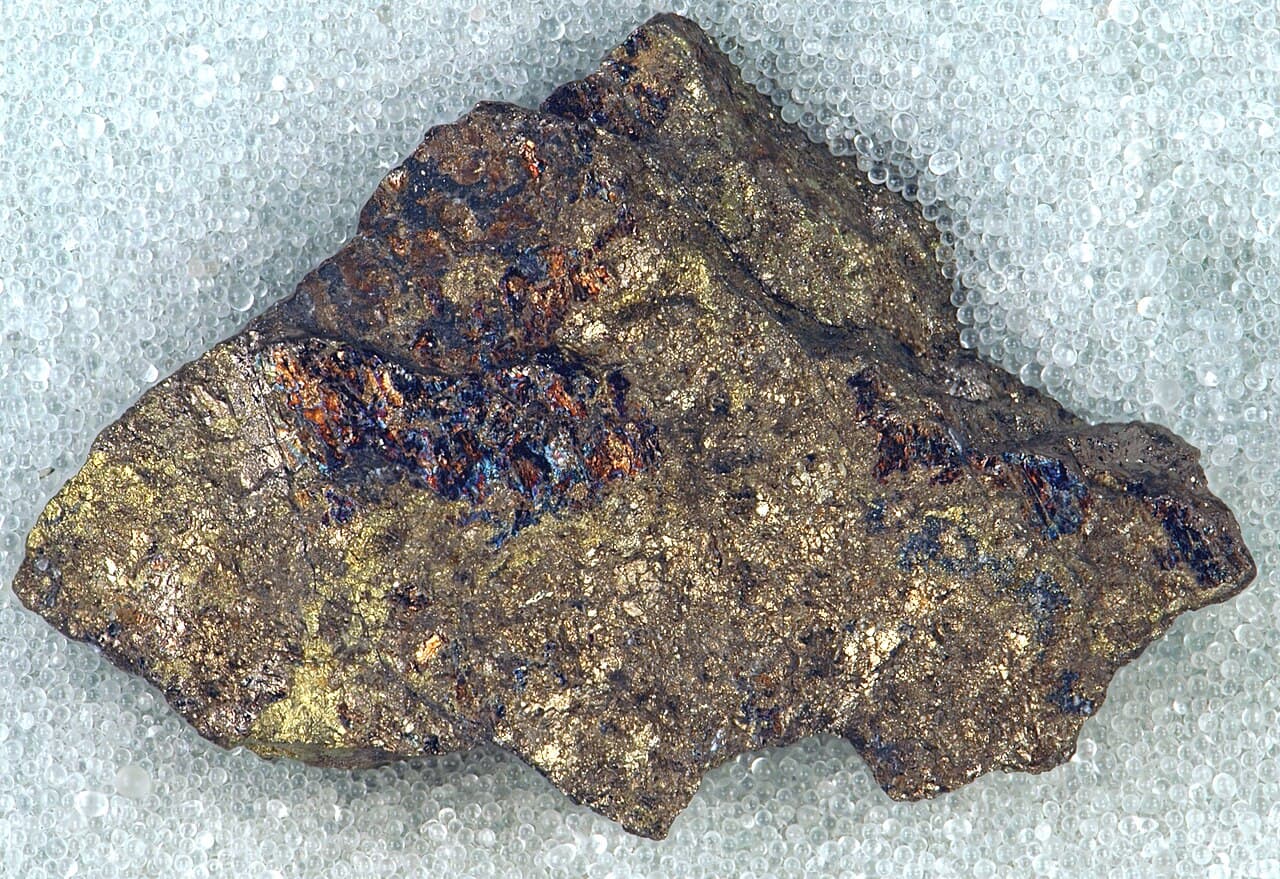
Cut slab in which bronze and purple-iridescent sulfide forms an interlocking mass through darker silicate host rock.
Massive sulfide from a layered mafic intrusion. Sulfide of this kind did not precipitate from water: it separated as an immiscible liquid inside a silicate magma once that magma became sulfide-saturated, and then settled. The same metals, concentrated by a mechanism that involves no fluid at all. Locality: Stillwater Mine, Beartooth Mountains, Montana, United States, as stated by the source.

James St. John, CC BY 2.0 · CC-BY-2.0 · source · Derivative: Downscaled to 1200 px wide by the Wikimedia thumbnail service; no cropping, no colour or content alteration.

Classification

system class
magmatic
model provenance
publishedModel

System architecture

The chain from source to what may be observed. A limb is shown only where Lithoen has recorded it from a source; nothing here identifies a place, ranks ground or implies that a deposit exists.

  1. Source

    Where the system draws its components from. Each edge names the component it refers to; source differs between systems and is never generalised.

    • Continental crustmodelled

      component
      Sulfur, and the contamination that lowers the sulfur solubility of the magma.
      precisionNote
      The model judges the rocks encountered during ascent more important for reaching sulfur saturation than those at the final level of emplacement.
    • Mantle (reservoir)inferred

      component
      Nickel, copper and platinum-group elements, carried up in mantle-derived mafic and ultramafic magma.
      method
      Osmium isotope compositions of the Noril’sk ore-bearing intrusions and their ores, which fall near mantle values.
  2. Transport

    What moves the components, and under what conditions. What a medium can carry depends on temperature, pressure, salinity and redox state, so every edge states the conditions it holds under.

    • Immiscible sulfide liquidestablished

      conditions
      An immiscible sulfide liquid within a mafic or ultramafic silicate magma, above the silicate solidus. There is no aqueous fluid in this limb of the system.
  3. Pathway and focusing

    What concentrated the flow. The presence of a structure is never on its own evidence that it focused anything, so each edge states the basis for the claim.

    • Magmatic crystallisationmodelled

      precisionNote
      The current model emphasises magma-conduit systems, in which repeated surges of magma allow the sulfide liquid to interact with a large volume of silicate melt. The corpus has no conduit entity, so the edge is carried against the magmatic process and the basis is stated here rather than implied by a structure.
  4. Deposition

    Why the components stopped moving. A system may use more than one mechanism, and different mechanisms leave different signatures.

  5. Minerals, in their role here

    Mineral role is a property of a mineral in a system, not of the mineral. The same species is an ore mineral in one system and gangue in another.

    • Pyriteinferred

      role
      gangue
      precisionNote
      Iron sulfide dominates the segregated liquid by volume; the nickel and copper sulfides that carry the metal are not among the IMA species recorded in this corpus, so only the iron sulfide role is stated.
  6. Modification and preservation

    What happened after the system finished. Formation is not preservation, and what is observed today is the sum of both.

    • Metamorphisminferred

      precisionNote
      Most known examples are Archean and Paleoproterozoic and have been deformed and metamorphosed; the cited evidence records the interpretive difficulty this creates rather than the overprinting itself.
    • Overprintingestablished

      precisionNote
      Contact metamorphism, recrystallisation and tenor upgrading through destruction of olivine all change what is observed relative to what formed.
    • Remobilisationestablished

      precisionNote
      Remobilisation operates twice in this system and in opposite directions: a later magma surge upgrades sulfide within the conduit, while post-emplacement cataclastic metamorphism disperses it.
  7. Commodity association

    A geological association only: a commodity characteristically won from this class of system where one is developed and preserved. No statement about any occurrence, and none about value.

  8. Tectonic and geological context

    The settings in which this system has been DOCUMENTED. Tectonic context is a necessary or common component of some models; it is not proof that mineralisation is present anywhere. Every entry states what else the setting contains.

    • Yilgarn Cratoninferred

      What else the setting contains
      Craton margins run for tens of thousands of kilometres worldwide.
      precisionNote
      A documented context, not a prediction. The setting is vastly more extensive than the systems found in it, and this edge asserts only that sources place the system here. The Yilgarn is one documented example of an Archean craton hosting this class; the model’s general statement is about craton margins, not about this craton.
    • Siberian Trapsinferred

      What else the setting contains
      Large igneous provinces cover millions of square kilometres. The model states that occurrences are on most continents while deposits of minable size and grade are rare, which is the ratio this edge must be read against.
      precisionNote
      A documented context, not a prediction. The setting is vastly more extensive than the systems found in it, and this edge asserts only that sources place the system here. The Siberian Traps stand here as the documented example, not as the only such province.
  9. Observable expressions

    Features commonly associated with this system — and, for each, what else produces the same observation. None of these demonstrates that a system operated anywhere, and Lithoen ranks nothing.

    • Basaltinferred

      What else produces this
      The tectonic setting is dominated by flood-basalt large igneous provinces, and flood basalt is one of the most voluminous rock types on Earth. The model records that occurrences are present on most continents while deposits of minable size and grade are rare, so the setting indicates almost nothing on its own.

How this record is known

6
Settled consensus
Cited as the accepted position of the discipline.
3
Interpretation
Reached by reasoning from evidence, or produced by a named model.

9 of 9 claims on this page cite at least one registered source. Counts describe how each statement is known, not how likely it is to be true.

What Lithoen records

Each claim states how it is known and cites its evidence.

EstablishedSulfide saturation and segregation of an immiscible sulfide liquid from mantle-derived magma.

Magmatic nickel-copper-platinum-group-element sulfide deposits are spatially and genetically related to mafic and ultramafic bodies, and form when mantle-derived magmas become sulfide-saturated and segregate an immiscible sulfide liquid, commonly after interaction with continental crustal rocks.

Evidence support: Supported by the cited evidence one source

Evidence: Schulz 2014 Primary authority

EstablishedUSGS magmatic sulfide-rich Ni-Cu-(PGE) occurrence model (SIR 2010–5070–I), Schulz and others.

This record represents the USGS Occurrence Model for Magmatic Sulfide-Rich Nickel-Copper-(Platinum-Group Element) Deposits Related to Mafic and Ultramafic Dike-Sill Complexes, chapter I of the Mineral Deposit Models series. Lithoen represents that model and does not extend it.

  • model: Occurrence Model for Magmatic Sulfide-Rich Nickel-Copper-(Platinum-Group Element) Deposits, Scientific Investigations Report 2010–5070–I.

Evidence support: Supported by the cited evidence one source

Evidence: Schulz 2014 Primary authority

EstablishedLater magma upgrades some sulfide and bypasses the rest; later metamorphism disperses, upgrades or recrystallises it.

Modification works in both directions in this system. A later surge of magma remobilises, upgrades and redeposits sulfide already accumulated in the conduit, while proto-ore injected into the footwall may stay shielded from later surges and from that upgrading. After emplacement, cataclastic metamorphism may remobilise and disperse the sulfides, metamorphism may upgrade disseminated sulfide by destroying olivine and releasing its nickel to the sulfides, and the sulfides may be recrystallised.

  • precision note: Neither direction can be assumed from an observation of the present state; what is seen is the sum of formation and everything since.

Evidence support: Supported by the cited evidence one source

Evidence: Schulz 2014 Primary authority

EstablishedThe model reports two published interpretations of the same deposits and settles neither.

For the Noril’sk deposits the USGS model records two competing interpretations. In one, magmas staged at intermediate crustal levels were contaminated by granitoid rocks, causing sulfide saturation and segregation of massive sulfide. In the other, based on rhenium–osmium isotopic compositions, the massive sulfides derive from a second, less contaminated magma. Lithoen does not adjudicate between them.

  • precision note: Recorded as established that the model reports competing interpretations. Lithoen retrieved one source; DISPUTED in this corpus is reserved for conflicting evidence from distinct sources, and is not asserted on a single report’s account of a debate.

Evidence support: Supported by the cited evidence one source

Evidence: Schulz 2014 Primary authority

EstablishedOccurrences are widespread; deposits of minable size and grade are rare.

The report notes that although magmatic nickel-copper sulfide occurrences are present on most continents, deposits of sufficient size and grade to be mined are relatively rare, with the major examples confined to Russia, China, Australia, Canada and southern Africa.

  • non uniqueness: Finding the system is not finding a deposit; the ratio of occurrences to major deposits is the plainest statement of that in the corpus.

Evidence support: Supported by the cited evidence one source

Evidence: Schulz 2014 Primary authority

Model outputCrustal contamination during ascent lowers sulfur solubility or adds sulfur, forcing saturation.

A common trigger for sulfur saturation is interaction between sulfur-undersaturated magma and crustal rocks. Incorporating country rock can change the temperature and composition of the magma, lowering its sulfur solubility, adding sulfur, or both; the report judges the rocks encountered during ascent more important for reaching saturation than those at the final level of emplacement.

  • model: USGS magmatic Ni-Cu-(PGE) occurrence model.
  • conditions: Sulfur-undersaturated mafic or ultramafic magma ascending through crust that may be sulfur-bearing.

Evidence support: Supported by the cited evidence one source

Evidence: Schulz 2014 Primary authority

InferredMantle-derived magma carries the metals; crust supplies sulfur and the trigger.

The metals come with the magma from the mantle. Osmium isotope data from the Noril’sk ore-bearing intrusions and their ores fall in a range similar to mantle compositions, which the report reads as indicating derivation from a primitive mantle magma that experienced little crustal contamination.

  • component: Nickel, copper and platinum-group elements.
  • method: Rhenium–osmium isotope compositions compared with mantle values.
  • precision note: The isotopic argument is an interpretation of a signature, and the report records a competing reading of the same data.

Evidence support: Supported by the cited evidence one source

Evidence: Schulz 2014 Primary authority

EstablishedCraton margins, within large igneous provinces, away from ridges and arcs.

The bulk of the world’s large magmatic nickel-copper-PGE deposits appear to be located near the margins of cratonic blocks, where large volumes of dominantly tholeiitic mafic and lesser ultramafic magma were emplaced and erupted by processes not associated with normal spreading-ridge or subduction environments — that is, within large igneous provinces.

  • non uniqueness: Craton margins run for tens of thousands of kilometres and large igneous provinces cover millions of square kilometres. The model itself records that occurrences are present on most continents while deposits of minable size and grade are rare.

Evidence support: Supported by the cited evidence one source

Evidence: Schulz 2014 Primary authority

Model outputFlow-dynamic traps in the lower parts of conduits, recharged by repeated magma surges.

The immiscible sulfide liquid segregates into physical depressions and similar sites in the lower parts of dike- and sill-like intrusions, where magma flow dynamics change. The report states that deposits of sufficient size and grade to be mined are associated almost exclusively with dynamic systems experiencing repeated magma surges, which allow the sulfide liquid to interact with a large volume of silicate magma.

  • model: USGS magmatic Ni-Cu-(PGE) occurrence model, whose current framing emphasises magma-conduit systems.
  • non uniqueness: Mafic and ultramafic conduits are common; the report records that occurrences are present on most continents while deposits of minable size and grade are rare.

Evidence support: Supported by the cited evidence one source

Evidence: Schulz 2014 Primary authority

In the knowledge graph

  • Magmatic nickel-copper-PGE sulfide system is a model interpreted for Jinchuan
  • Magmatic nickel-copper-PGE sulfide system is a model interpreted for Kabanga
  • Magmatic nickel-copper-PGE sulfide system is associated with the commodity Cobalt (commodity)
  • Magmatic nickel-copper-PGE sulfide system is associated with the commodity Copper (commodity)
  • Magmatic nickel-copper-PGE sulfide system is associated with the commodity Nickel (commodity)
  • Magmatic nickel-copper-PGE sulfide system is associated with the commodity Platinum-group elements (commodity)
  • Magmatic nickel-copper-PGE sulfide system is documented in the tectonic context Yilgarn Craton
  • Magmatic nickel-copper-PGE sulfide system is documented in the tectonic context Siberian Traps
  • Magmatic nickel-copper-PGE sulfide system deposits by Sulfide saturation
  • Magmatic nickel-copper-PGE sulfide system deposits by Sulfide segregation
  • Magmatic nickel-copper-PGE sulfide system is focused by Magmatic crystallisation
  • Magmatic nickel-copper-PGE sulfide system may be indicated by Basalt
  • Magmatic nickel-copper-PGE sulfide system involves Pyrite
  • Magmatic nickel-copper-PGE sulfide system is modified by Metamorphism
  • Magmatic nickel-copper-PGE sulfide system is modified by Overprinting
  • Magmatic nickel-copper-PGE sulfide system is modified by Remobilisation
  • Magmatic nickel-copper-PGE sulfide system draws components from Continental crust
  • Magmatic nickel-copper-PGE sulfide system draws components from Mantle (reservoir)
  • Magmatic nickel-copper-PGE sulfide system transports components in Immiscible sulfide liquid
  • Magmatic nickel-copper-PGE sulfide system is a model interpreted for Noril’sk–Talnakh
  • Magmatic nickel-copper-PGE sulfide system is a model interpreted for Pechenga
  • Magmatic nickel-copper-PGE sulfide system is a model interpreted for Voisey’s Bay

Record last updated 2026-09-07. Corrections follow the published corrections policy; superseded claims are retained, never silently edited.