A dense, olivine-rich intrusive igneous rock. It is the principal rock of the upper mantle, and partial melting of peridotite is where most of Earth’s magma begins.
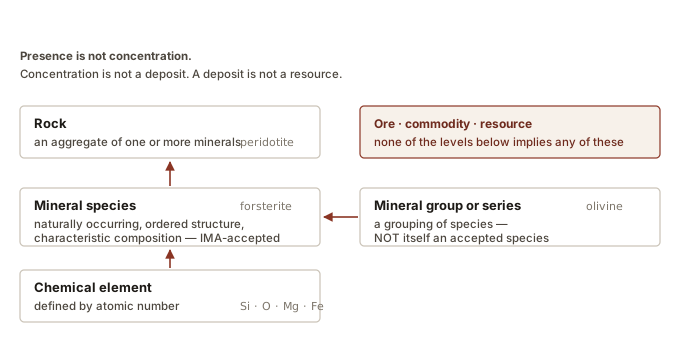
SchematicFour different kinds of thing that ordinary usage runs together. An element is defined by atomic number; a mineral species by structure and composition, and accepted by name; a mineral group gathers species and is not itself a species; a rock is an aggregate of minerals. None of these levels implies an ore, a commodity or a resource.Full description of this figure
Reading upward: chemical elements, defined by atomic number, with silicon, oxygen, magnesium and iron as examples. Above them, mineral species — naturally occurring, ordered in structure, with a characteristic composition, and accepted under that name by the International Mineralogical Association — with forsterite as an example. Beside them, mineral groups and series, which gather species and are explicitly not species themselves, with olivine as an example. Above, rocks, which are aggregates of one or more minerals, with peridotite as an example. Set apart in a bordered box: ore, commodity and resource, none of which follows from any level below.
Original Lithoen diagram · LITHOEN-ORIGINAL
Classification
rock class
igneous
igneous mode
intrusive
How this record is known
1
Settled consensus
Cited as the accepted position of the discipline.
1 of 1 claims on this page cite at least one registered source. Counts describe how each statement is known, not how likely it is to be true.
What Lithoen records
Each claim states how it is known and cites its evidence.
Established0.2–0.4 wt%m Nickel
Ultramafic rocks weathered to form nickel-cobalt laterites hold 0.2 to 0.4 percent nickel within olivine or serpentine, with nickel also present but less abundant in accessory pyroxene and chromite.
method: Reported by the USGS nickel-cobalt laterite deposit model as a characteristic of the protoliths of this deposit class.
sample material: Unweathered ultramafic protolith; the nickel is held in the silicate structure, not in a separate nickel mineral.
precision note: A protolith abundance for the class, not a measurement of any occurrence, and not a grade: the whole system is the process that turns this figure into something higher.
Evidence support: Supported by the cited evidence· one source