Each claim states how it is known and cites its evidence.
EstablishedThe majority of the world’s chromium reserves are hosted in stratiform chromitite seams.
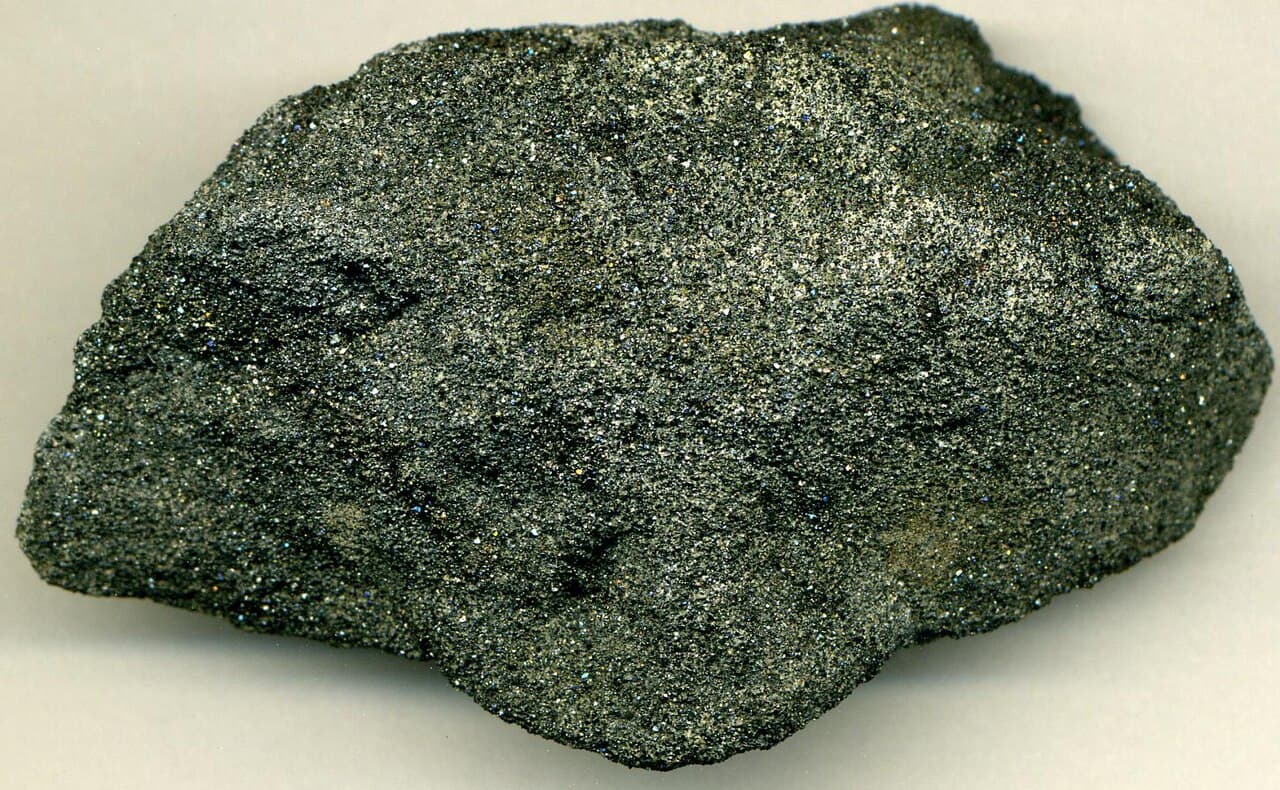
Chromitite seams within layered intrusions host the majority of the world’s chromium reserves and also contain significant platinum-group-element mineralisation.
- precision note: Reserve is the source’s term for a global aggregate. Lithoen carries the statement as reported and makes no reserve classification of its own.
Evidence support: Supported by the cited evidence · one source
Evidence: Schulte 2012 · Primary authority
EstablishedCyclic, laterally contiguous chromitite seams low in large layered mafic-ultramafic intrusions.
Stratiform chromite deposits are massive chromitite bodies or seams of disseminated chromite in large, unmetamorphosed, repetitively layered mafic-ultramafic intrusions emplaced in stable cratonic settings or during rifting; the seams lie in the lower ultramafic parts of the intrusions and are cyclic and laterally contiguous across them.
Evidence support: Supported by the cited evidence · one source
Evidence: Schulte 2012 · Primary authority
EstablishedThe model reports magma mixing as the most widely accepted explanation and the mechanism as still contested.
The USGS model records that the most widely accepted explanation for stratiform chromite formation involves mixing of primitive and fractionated magmas, and that the mechanism or mechanisms responsible remain controversial — including a proposal that some layering formed by downward infiltration of a picritic melt.
- precision note: Recorded as established that the model reports a continuing controversy, not as a disputed Lithoen claim: Lithoen retrieved one source, which documents both positions. A DISPUTED status in this corpus means Lithoen holds conflicting evidence from distinct sources, which is a stronger statement than reporting that a debate exists.
Evidence support: Supported by the cited evidence · one source
Evidence: Schulte 2012 · Primary authority
EstablishedUSGS Stratiform Chromite Deposit Model (SIR 2010–5070–E), Schulte and others.
This record represents the USGS Stratiform Chromite Deposit Model, chapter E of the Mineral Deposit Models for Resource Assessment series. Lithoen represents that model and does not extend it.
- model: Stratiform Chromite Deposit Model, Scientific Investigations Report 2010–5070–E.
Evidence support: Supported by the cited evidence · one source
Evidence: Schulte 2012 · Primary authority
EstablishedNo definitive model exists for the formation of laterally extensive chromitite layers.
The report states that there is no definitive model for how laterally extensive chromitite layers form, and notes the difficulty of explaining how a viscous liquid of low density could mix efficiently with a large body of underlying denser magma to produce uniform, laterally extensive chromite layers.
- precision note: The absence is stated by the source itself, which is what makes it recordable as established rather than as a Lithoen judgement.
Evidence support: Supported by the cited evidence · one source
Evidence: Schulte 2012 · Primary authority
InferredChromium is magmatic, concentrated by crystallisation rather than carried by a fluid.
The chromium is carried by the mafic-ultramafic magma itself and is concentrated by crystallisation within the intrusion; there is no separate transporting fluid in this system.
- component: Chromium.
- method: Follows from the model’s description of chromitite as a cumulate phase in a layered intrusion, with the candidate mechanisms all internal to the magma chamber.
Evidence support: Supported by the cited evidence · one source
Evidence: Schulte 2012 · Primary authority
EstablishedStable cratonic interiors and their margins, with structural exceptions the model names.
Most of the large layered mafic-ultramafic intrusions that host stratiform chromite formed in stable mid-continent anorogenic provinces or near their margins — the Bushveld in the Kaapvaal craton, the Great Dyke in the Zimbabwe craton along the Archean–Proterozoic boundary. Some instead exploited pre-existing discontinuities such as shears and basement–cover unconformities, or were deformed and faulted after crystallisation.
- non uniqueness: Stable cratonic interiors are, by area, a large fraction of the continents, and almost none of that area contains a layered intrusion.
Evidence support: Supported by the cited evidence · one source
Evidence: Schulte 2012 · Primary authority