A group of orthosilicate minerals, not a species. Natural olivine is a solid solution between forsterite and fayalite, and it is those end members — not “olivine” — that the IMA list accepts.
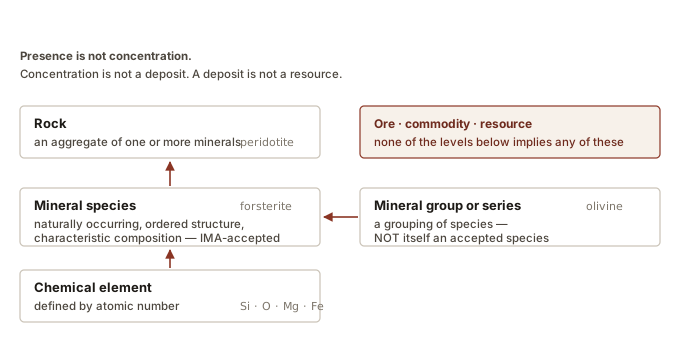
SchematicFour different kinds of thing that ordinary usage runs together. An element is defined by atomic number; a mineral species by structure and composition, and accepted by name; a mineral group gathers species and is not itself a species; a rock is an aggregate of minerals. None of these levels implies an ore, a commodity or a resource.Full description of this figure
Reading upward: chemical elements, defined by atomic number, with silicon, oxygen, magnesium and iron as examples. Above them, mineral species — naturally occurring, ordered in structure, with a characteristic composition, and accepted under that name by the International Mineralogical Association — with forsterite as an example. Beside them, mineral groups and series, which gather species and are explicitly not species themselves, with olivine as an example. Above, rocks, which are aggregates of one or more minerals, with peridotite as an example. Set apart in a bordered box: ore, commodity and resource, none of which follows from any level below.
Original Lithoen diagram · LITHOEN-ORIGINAL
Classification
group kind
group
How this record is known
2
Settled consensus
Cited as the accepted position of the discipline.
2 of 2 claims on this page cite at least one registered source. Counts describe how each statement is known, not how likely it is to be true.
What Lithoen records
Each claim states how it is known and cites its evidence.
EstablishedNot a species; a group.
“Olivine” is not an accepted mineral species: no entry of that name appears in the IMA List of Minerals. It denotes a solid-solution series between forsterite and fayalite.
definition basis: Absence from the IMA List of Minerals, which is the list of accepted species.
precision note: The name remains in ordinary scientific use. It is recorded as a grouping so that it stays usable without being mistaken for a species.
Evidence support: Supported by the cited evidence· one source
EstablishedContinuous Mg–Fe substitution between forsterite and fayalite.
Olivine is a continuous solid solution between forsterite and fayalite: the two end members share a structure and differ by the substitution of iron for magnesium, so a natural olivine has a composition somewhere along that line rather than either end-member formula.
precision note: The IMA list accepts the end members as species; the intermediate compositions are described by naming the series and the proportion, not by inventing new species names.
Evidence support: Supported by the cited evidence· one source
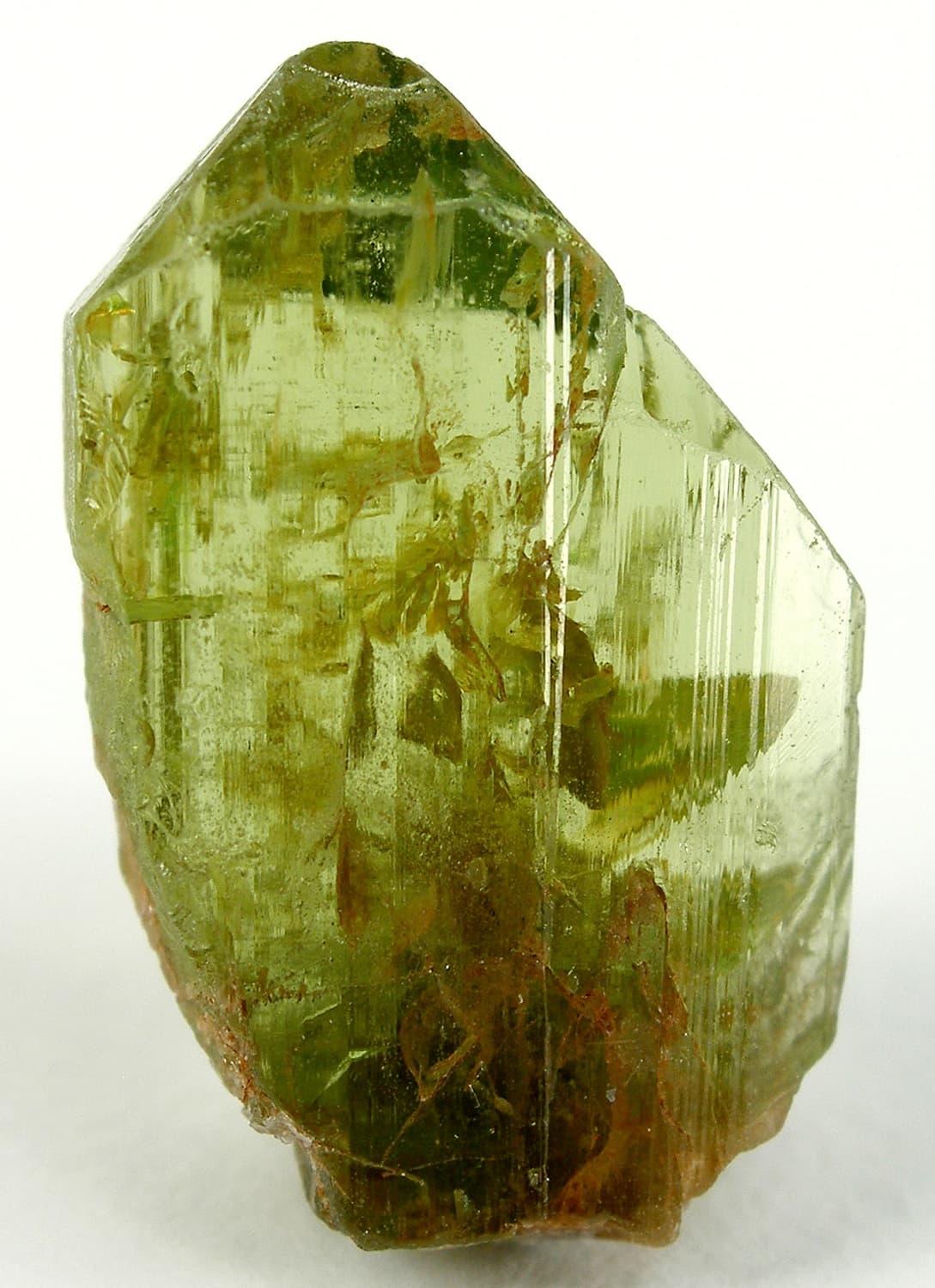
A forsterite crystal specimen. Forsterite is the magnesium end member of the olivine series and the dominant mineral of the upper mantle; natural olivines sit somewhere between it and the iron end member, fayalite.
Robert M. Lavinsky, CC BY-SA 3.0 · CC-BY-SA-3.0 · source · Derivative: Downscaled to 1000 px wide by the Wikimedia thumbnail service; no cropping, no colour or content alteration.
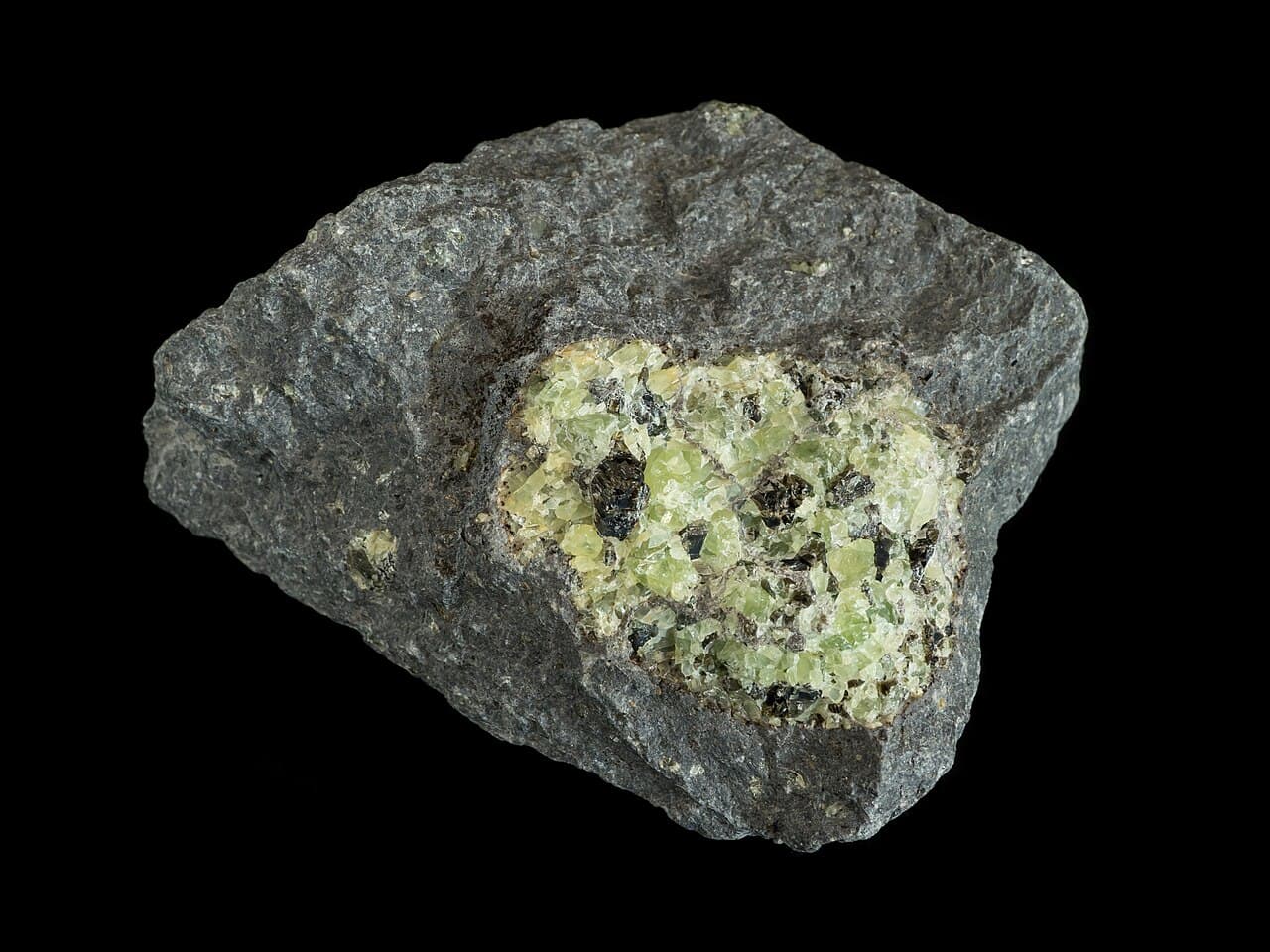
An olivine-rich nodule enclosed in basalt, from Smrčí, Czech Republic. Nodules like this are fragments of mantle rock carried upward by erupting magma, which is why they matter: they are among the few pieces of the mantle that can be held. Locality: Smrčí, Czech Republic.
Zbynek Burival, CC BY-SA 4.0 · CC-BY-SA-4.0 · source · Derivative: Downscaled to 1200 px wide by the Wikimedia thumbnail service; no cropping, no colour or content alteration.
Record last updated 2026-09-06. Corrections follow the published corrections policy; superseded claims are retained, never silently edited.