The mineral class built from silicon–oxygen tetrahedra, subdivided by how those tetrahedra link: isolated, in chains, in sheets, or in three-dimensional frameworks.
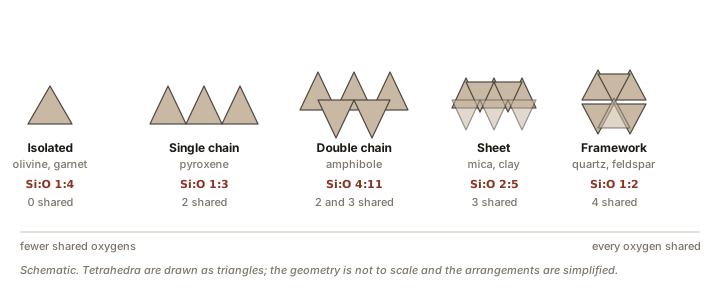
SchematicHow silicon–oxygen tetrahedra link, and what each arrangement produces. Sharing more oxygens between tetrahedra lowers the oxygen content relative to silicon, from 1:4 in isolated tetrahedra to 1:2 in a framework — which is why the structural class can be read from the formula.Full description of this figure
The diagram sets out five structural classes of silicate. Isolated tetrahedra share no oxygens and give Si:O of 1:4, as in olivine and garnet. Single chains share two oxygens per tetrahedron, giving 1:3, as in pyroxene. Double chains share two and three alternately, giving 4:11, as in amphibole. Sheets share three, giving 2:5, as in mica and clay. Frameworks share all four, giving 1:2, as in quartz and feldspar. Moving left to right is a progression of increasing polymerisation.
Original Lithoen diagram · LITHOEN-ORIGINAL
Classification
group kind
informal
How this record is known
1
Settled consensus
Cited as the accepted position of the discipline.
1
Interpretation
Reached by reasoning from evidence, or produced by a named model.
2 of 2 claims on this page cite at least one registered source. Counts describe how each statement is known, not how likely it is to be true.
What Lithoen records
Each claim states how it is known and cites its evidence.
Established6,239 protons
The IMA List of Minerals records 6,239 currently valid mineral species as of September 2026.
precision note: A count of accepted species at a stated date; the list is updated regularly and the number changes.
definition basis: Counted by the CNMNC in its own list; the unit code records that this is a count, not a measurement.
Evidence support: Supported by the cited evidence· one source
Silicates are organised by how their SiO4 tetrahedra connect: isolated tetrahedra in olivine and garnet, single chains in pyroxene, double chains in amphibole, sheets in mica and clay, and three-dimensional frameworks in quartz and feldspar.
method: Read from the approved formulas: the ratio of silicon to oxygen falls from 1:4 in isolated tetrahedra to 1:2 in frameworks as tetrahedra come to share more of their oxygens.
precision note: Lithoen holds no source that states the structural classification directly; the classes are inferred from the formulas the IMA list gives, and the claim is marked accordingly.
Evidence support: Supported by the cited evidence· one source