Skip to content
LITHOEN

Mineral group

Pyroxene

Single-chain silicates divided into orthopyroxenes and clinopyroxenes. Like olivine, a group name rather than a species.

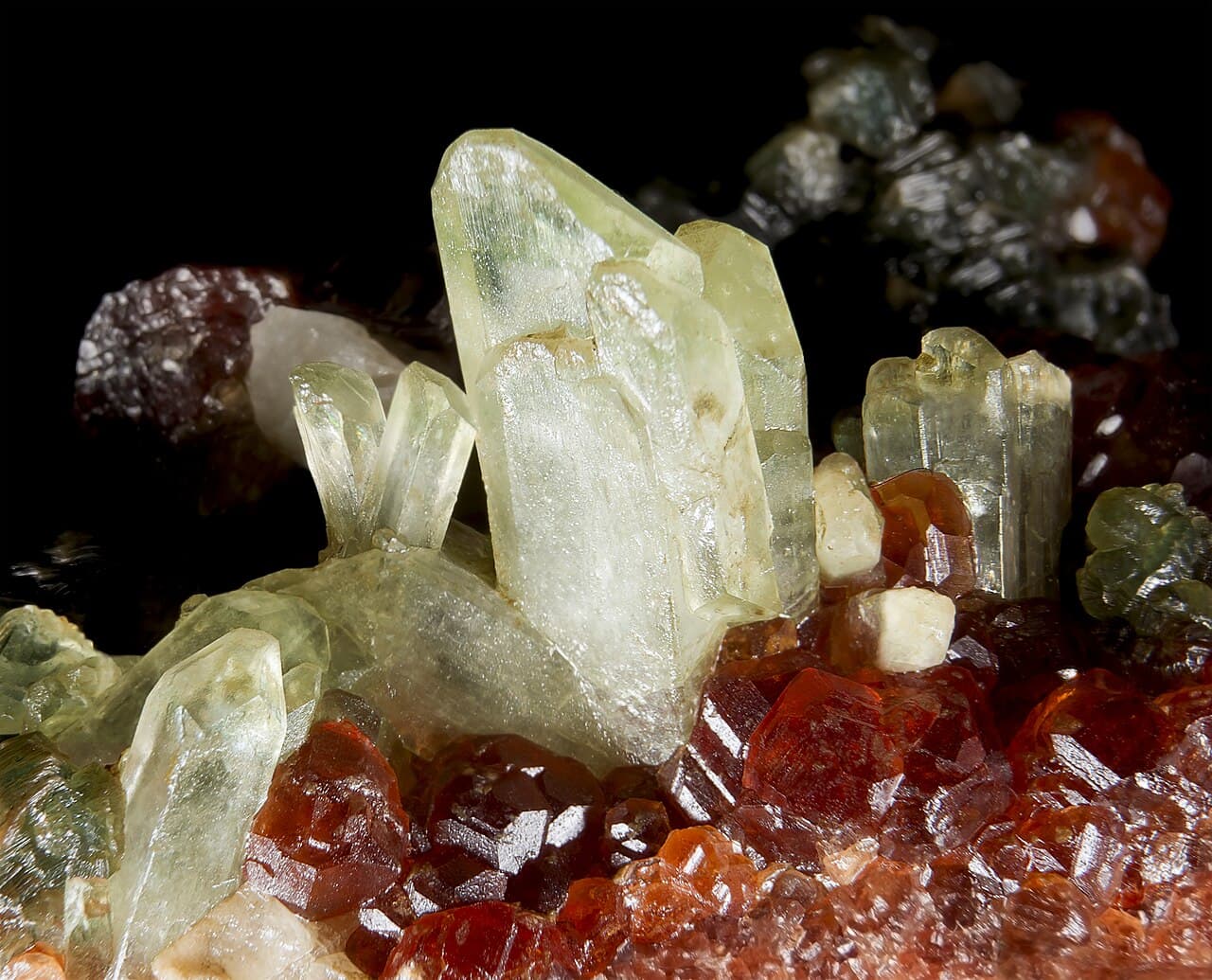
Pale green prismatic diopside crystals on a rock matrix.
Diopside from Aosta, Italy. Diopside is a calcium–magnesium clinopyroxene: a single-chain silicate, and one of the principal minerals of the mantle and of calcium-rich metamorphic rocks. Locality: Aosta, Italy.

Didier Descouens, CC BY-SA 3.0 · CC-BY-SA-3.0 · source · Derivative: Downscaled to 1000 px wide by the Wikimedia thumbnail service; no cropping, no colour or content alteration.

Classification

group kind
group

How this record is known

2
Settled consensus
Cited as the accepted position of the discipline.

2 of 2 claims on this page cite at least one registered source. Counts describe how each statement is known, not how likely it is to be true.

What Lithoen records

Each claim states how it is known and cites its evidence.

EstablishedEnstatite–ferrosilite substitution; augite as a variable-composition clinopyroxene.

The orthopyroxene series runs between enstatite, Mg2Si2O6, and ferrosilite, Fe2+2Si2O6, by the same iron–magnesium substitution that governs olivine; augite, the common clinopyroxene, carries a formula written with variable cations because its composition genuinely varies.

Evidence support: Supported by the cited evidence one source

Evidence: Commission on New Minerals, Nomenclature and Classification, International Mineralogical Association 2026 Primary authority

EstablishedNot a species; a group.

“Pyroxene” is not an accepted mineral species: no entry of that name appears in the IMA List of Minerals. It denotes a group of single-chain silicates including diopside, enstatite and augite.

  • definition basis: Absence from the IMA List of Minerals, which is the list of accepted species.
  • precision note: The name remains in ordinary scientific use. It is recorded as a grouping so that it stays usable without being mistaken for a species.

Evidence support: Supported by the cited evidence one source

Evidence: Commission on New Minerals, Nomenclature and Classification, International Mineralogical Association 2026 Primary authority

In the knowledge graph

Record last updated 2026-09-06. Corrections follow the published corrections policy; superseded claims are retained, never silently edited.