Skip to content
LITHOEN

Mineral

Quartz

A hard, chemically simple silicate mineral (silicon dioxide) that is among the most abundant minerals of the continental crust and the index mineral for hardness 7 on the Mohs scale.

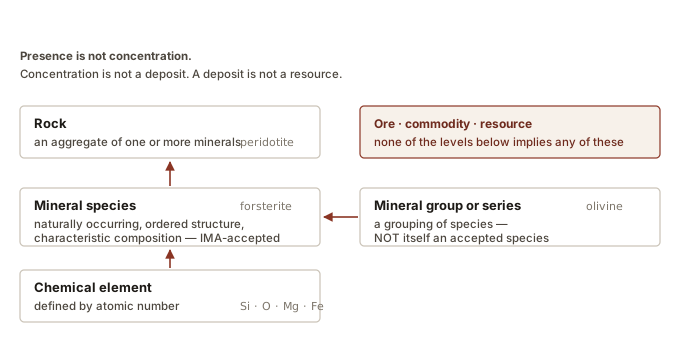
A stacked diagram with chemical element at the base, mineral species above it, mineral group to the side, and rock at the top, with a separate boxed note that ore, commodity and resource are not implied by any of them.
SchematicFour different kinds of thing that ordinary usage runs together. An element is defined by atomic number; a mineral species by structure and composition, and accepted by name; a mineral group gathers species and is not itself a species; a rock is an aggregate of minerals. None of these levels implies an ore, a commodity or a resource.
Full description of this figure

Reading upward: chemical elements, defined by atomic number, with silicon, oxygen, magnesium and iron as examples. Above them, mineral species — naturally occurring, ordered in structure, with a characteristic composition, and accepted under that name by the International Mineralogical Association — with forsterite as an example. Beside them, mineral groups and series, which gather species and are explicitly not species themselves, with olivine as an example. Above, rocks, which are aggregates of one or more minerals, with peridotite as an example. Set apart in a bordered box: ore, commodity and resource, none of which follows from any level below.

Original Lithoen diagram · LITHOEN-ORIGINAL

Classification

formula
SiO2
ima status
approved
crystal system
trigonal

How this record is known

7
Settled consensus
Cited as the accepted position of the discipline.

7 of 7 claims on this page cite at least one registered source. Counts describe how each statement is known, not how likely it is to be true.

What Lithoen records

Each claim states how it is known and cites its evidence.

EstablishedIMA CNMNC, via the IMA List of Minerals.

General principle, shown here for context — not an observation about this record.

The Commission on New Minerals, Nomenclature and Classification of the International Mineralogical Association approves new minerals and rules on the status of mineral species; its list describes itself as the primary and official source on minerals.

  • generality: GENERAL_PRINCIPLE

Evidence support: Supported by the cited evidence one source

Evidence: Commission on New Minerals, Nomenclature and Classification, International Mineralogical Association 2026 Primary authority

EstablishedA = approved, G = grandfathered, Rd = redefined, Rn = renamed, Q = questionable.

General principle, shown here for context — not an observation about this record.

The IMA list assigns each name a status: approved for species accepted since the IMA was established in 1958, grandfathered for those described earlier and generally considered valid, redefined, renamed, or questionable where a mineral is poorly characterised and its validity doubtful.

  • generality: GENERAL_PRINCIPLE

Evidence support: Supported by the cited evidence one source

Evidence: Commission on New Minerals, Nomenclature and Classification, International Mineralogical Association 2026 Primary authority

EstablishedNaturally occurring, inorganic, ordered internal structure, characteristic composition and properties.

A mineral is a naturally occurring inorganic element or compound with an orderly internal structure and a characteristic chemical composition, crystal form and physical properties.

  • precision note: “Characteristic composition” allows for substitution; it does not mean a fixed formula in every natural sample.

Evidence support: Supported by the cited evidence one source

Evidence: U.S. Geological Survey n.d. Primary authority

EstablishedNaturally occurring, with distinctive composition, properties and atomic structure.

A mineral is a naturally occurring substance with distinctive chemical and physical properties, composition and atomic structure.

Evidence support: Supported by the cited evidence 2 sources, multiple sources, independence unknown

Evidence: British Geological Survey n.d. Primary authority; U.S. Geological Survey n.d. Primary authority

Established2.65 g/cm3

The measured density of quartz is 2.65 grams per cubic centimetre (2.59–2.63 when massive).

  • precision note: Reference value from a compiled data sheet; 2.59–2.63 g/cm3 when massive, calculated 2.66 g/cm3.

Evidence support: Supported by the cited evidence one source

Evidence: Mineral Data Publishing 2001 Institutional reference

EstablishedSiO2

Quartz is an accepted mineral species in the IMA List of Minerals, with the CNMNC-approved formula SiO2 and IMA status “approved”.

  • definition basis: IMA List of Minerals, September 2026 update, which is the authority on mineral species status.
  • precision note: An approved formula is an idealised composition; natural crystals of most species depart from it through substitution.

Evidence support: Supported by the cited evidence one source

Evidence: Commission on New Minerals, Nomenclature and Classification, International Mineralogical Association 2026 Primary authority

Established7 on the Mohs scale

Quartz has a hardness of 7 on the Mohs scale, of which it is the defining index mineral for that value.

  • definition basis: Index mineral for 7 on the Mohs ordinal hardness scale; the reference notes hardness is variable by direction and form.

Evidence support: Supported by the cited evidence one source

Evidence: Mineral Data Publishing 2001 Institutional reference

In the knowledge graph

Figures

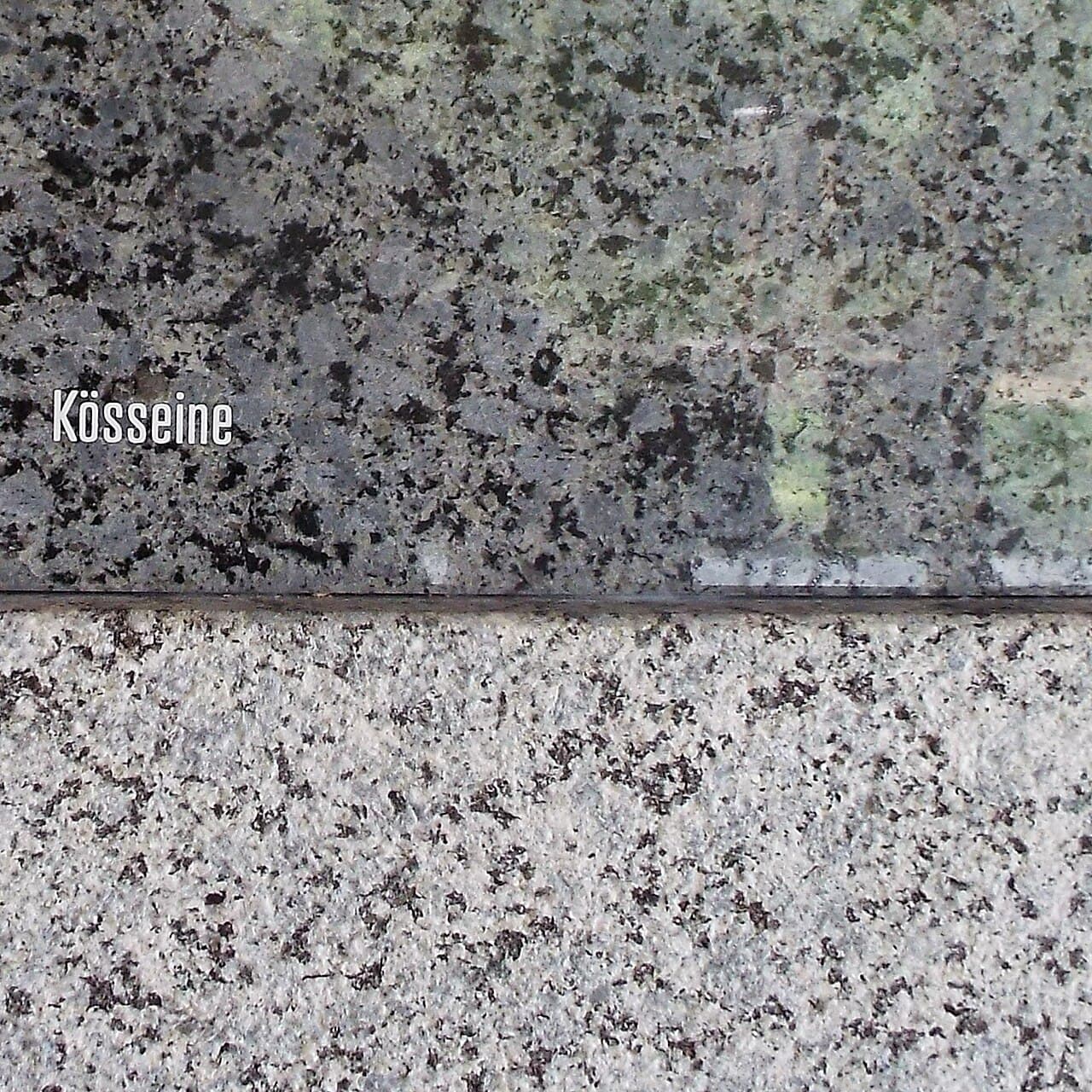
A cut and polished granite surface showing interlocking pale and dark crystals a few millimetres across.
A granite from the Kösseine massif, Germany. The interlocking crystals of quartz, feldspar and mica are visible without magnification — the coarse texture that records slow cooling at depth. Locality: Kösseine, Bavaria, Germany.

Georgenhausen, CC BY-SA 4.0 · CC-BY-SA-4.0 · source · Derivative: Downscaled to 1000 px wide by the Wikimedia thumbnail service; no cropping, no colour or content alteration.

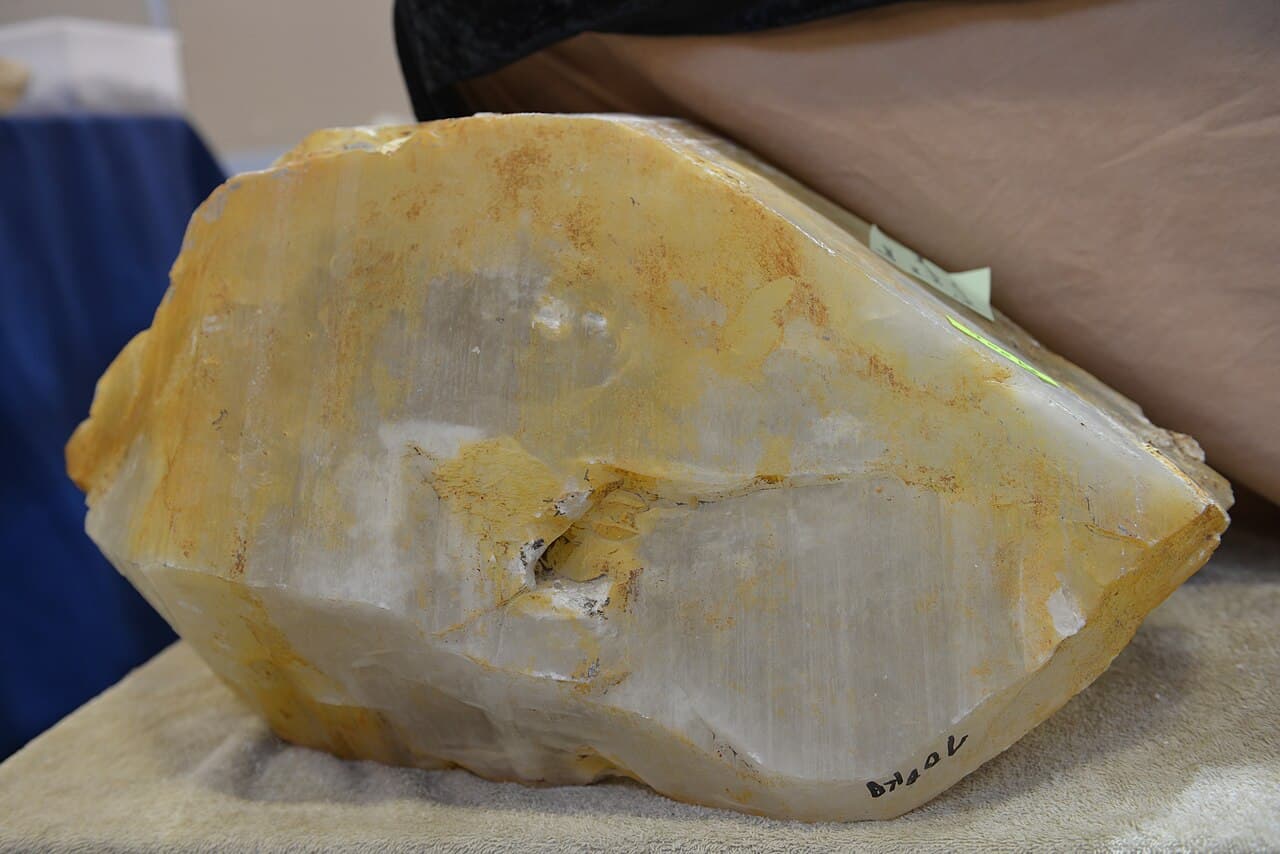
A large colourless prismatic quartz crystal terminated by pyramidal faces.
A large quartz crystal from the Shigar Valley, Pakistan. Quartz is a framework silicate in which every oxygen is shared between two tetrahedra, giving the composition SiO2. Locality: Shigar Valley, Pakistan.

LZ6387, CC BY-SA 4.0 · CC-BY-SA-4.0 · source · Derivative: Downscaled to 1000 px wide by the Wikimedia thumbnail service; no cropping, no colour or content alteration.

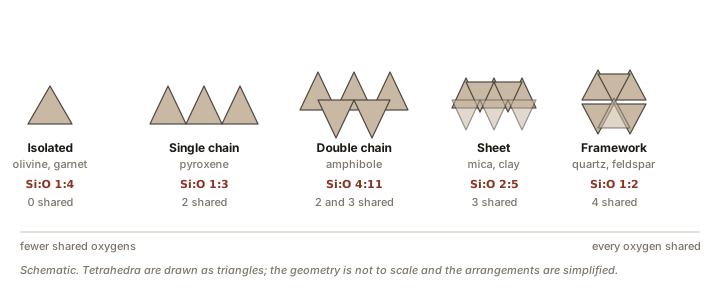
Five groups of triangles representing silicon-oxygen tetrahedra, arranged as isolated units, a single chain, a double chain, a sheet and a framework, each labelled with example minerals and a silicon-to-oxygen ratio.
SchematicHow silicon–oxygen tetrahedra link, and what each arrangement produces. Sharing more oxygens between tetrahedra lowers the oxygen content relative to silicon, from 1:4 in isolated tetrahedra to 1:2 in a framework — which is why the structural class can be read from the formula.
Full description of this figure

The diagram sets out five structural classes of silicate. Isolated tetrahedra share no oxygens and give Si:O of 1:4, as in olivine and garnet. Single chains share two oxygens per tetrahedron, giving 1:3, as in pyroxene. Double chains share two and three alternately, giving 4:11, as in amphibole. Sheets share three, giving 2:5, as in mica and clay. Frameworks share all four, giving 1:2, as in quartz and feldspar. Moving left to right is a progression of increasing polymerisation.

Original Lithoen diagram · LITHOEN-ORIGINAL

Record last updated 2026-09-06. Corrections follow the published corrections policy; superseded claims are retained, never silently edited.