The production of liquid from only part of a solid rock, leaving a residue behind. Almost all magma on Earth is generated this way; the conditions that trigger it differ from setting to setting.
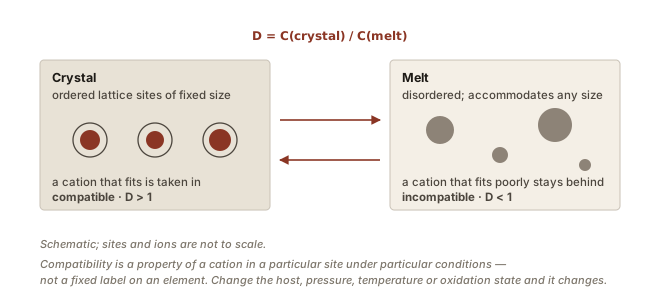
SchematicWhether an element enters a growing crystal or stays in the melt depends on how well its charge and radius fit the lattice site on offer. The partition coefficient D expresses that as a ratio — but it is a ratio for one cation, one site and one set of conditions, not a property of the element.Full description of this figure
On the left, a crystal is drawn with three lattice sites of fixed size, each holding a cation. A cation whose charge and radius fit a site is taken into the crystal and is called compatible, with a partition coefficient greater than one. On the right, a melt is drawn as a disordered field able to accommodate cations of any size; a cation that fits the crystal sites poorly is left there and is called incompatible, with a partition coefficient below one. Arrows run in both directions between the two. The partition coefficient D is defined as the concentration in the crystal divided by the concentration in the melt. The figure is labelled schematic and carries the caution that compatibility is a property of a cation in a particular site under particular conditions.
Original Lithoen diagram · LITHOEN-ORIGINAL
How this record is known
2
Settled consensus
Cited as the accepted position of the discipline.
1
Interpretation
Reached by reasoning from evidence, or produced by a named model.
3 of 3 claims on this page cite at least one registered source. Counts describe how each statement is known, not how likely it is to be true.
What Lithoen records
Each claim states how it is known and cites its evidence.
EstablishedSome rock melts at depth, and the melt rises because it is less dense than its surroundings.
Deep within the Earth it is hot enough that some rocks slowly melt, becoming a thick flowing substance; because this melt is lighter than the solid rock around it, it rises and collects in magma chambers before some pushes through vents and fissures to the surface.
Evidence support: Supported by the cited evidence· one source
InferredMelt composition is set by partitioning, not by the source composition.
A melt does not have the composition of the rock it came from. Partial melting divides elements between the liquid and the solid residue according to how each element partitions, so the melt is enriched in what the crystals reject and the residue in what they retain.
method: Follows directly from partitioning: if elements divide unequally between crystal and liquid, an incomplete melt cannot have the composition of its source.
Evidence support: Supported by the cited evidence· 2 sources, multiple sources, independence unknown