Each claim states how it is known and cites its evidence.
EstablishedGoverned by cation size and charge against the size and elasticity of the receiving lattice site.
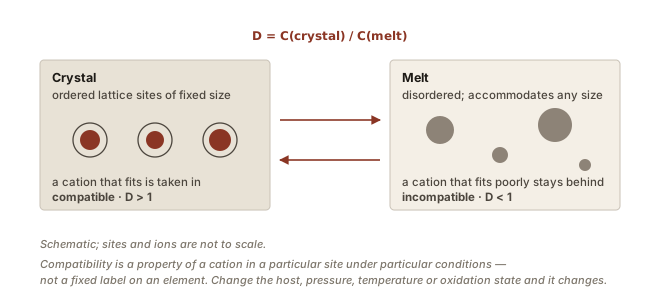
The partitioning of any series of isovalent cations can be rationalised by the size and elasticity of the crystal lattice site that receives them, with site elasticity varying linearly with the formal charge of the cation. Partitioning is a property of a cation and a site together, not of an element alone.
- model: The lattice-strain model of Blundy & Wood (1994), which predicts partitioning from the physical characteristics of cation sites in the crystal.
- precision note: The model was demonstrated on 15 elements partitioning between silicate minerals and coexisting melts.
Evidence support: Supported by the cited evidence · one source
Evidence: Blundy 1994 · Peer-reviewed
InferredCompatible and incompatible are behaviours under stated conditions, not intrinsic labels.
Compatibility is not a permanent property of an element. Whether an element is taken into a crystal or left in the melt depends on which crystal, which melt, and under what pressure, temperature and oxidation state — and therefore changes from setting to setting.
- method: Follows from the lattice-strain result: if behaviour is set by the fit between a cation and a particular site, then changing the host phase changes the behaviour.
Evidence support: Supported by the cited evidence · one source
Evidence: Blundy 1994 · Peer-reviewed
EstablishedPrediction from first principles was not available before the lattice-strain treatment.
Before the lattice-strain model, quantitative prediction of crystal–melt partition coefficients from thermodynamic principles had not been possible; partition coefficients were measured case by case rather than derived.
Evidence support: Supported by the cited evidence · one source
Evidence: Blundy 1994 · Peer-reviewed
EstablishedPartitioning between coexisting crystal and liquid is what governs magmatic and planetary differentiation.
Many geochemical processes — the crystallisation of silicate magmas, planetary differentiation — cannot be understood without knowing how elements divide between coexisting crystal and liquid phases.
Evidence support: Supported by the cited evidence · one source
Evidence: Blundy 1994 · Peer-reviewed