Skip to content
LITHOEN

Mineral system

Mississippi Valley-type system

Also known as MVT system

A low-temperature system in which brines expelled from a sedimentary basin migrate through platform carbonates and precipitate lead and zinc sulfides where fluids mix or conditions change. It involves no magmatism at all, which is precisely why it belongs in the canon.

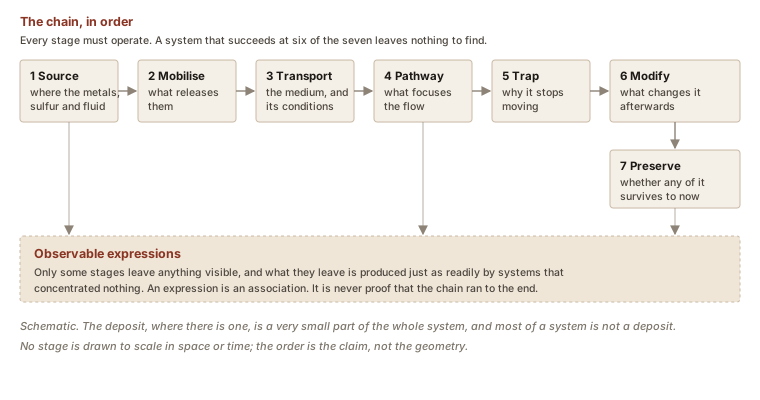
A schematic left-to-right chain of seven linked stages above a separate dashed band labelled observable expressions, with arrows running down from three of the stages into that band.
SchematicThe seven stages Lithoen records for every system: source, mobilisation, transport, pathway, trap, modification, preservation — with the observable expressions drawn as a separate band beneath, because only some stages leave anything to see. The order is the claim; nothing here is to scale in space or time, and the deposit, where there is one, is a very small part of the whole.

Original Lithoen diagram · LITHOEN-ORIGINAL

Classification

system class
basinal
model provenance
publishedModel

System architecture

The chain from source to what may be observed. A limb is shown only where Lithoen has recorded it from a source; nothing here identifies a place, ranks ground or implies that a deposit exists.

  1. Source

    Where the system draws its components from. Each edge names the component it refers to; source differs between systems and is never generalised.

    • Continental crustestablished

      component
      Metals and sulfur, both from crustal sources rather than from a magma.
    • Limestoneestablished

      component
      The carbonate host that is replaced by sulfides and dissolved to make the space they occupy.
  2. Transport

    What moves the components, and under what conditions. What a medium can carry depends on temperature, pressure, salinity and redox state, so every edge states the conditions it holds under.

    • Basinal brineestablished

      conditions
      Basinal brine of about 10 to 30 weight percent salts at ore-deposition temperatures typically between 75 and about 200 degrees Celsius.
  3. Pathway and focusing

    What concentrated the flow. The presence of a structure is never on its own evidence that it focused anything, so each edge states the basis for the claim.

    • Chemical weatheringinferred

      precisionNote
      Dissolution collapse breccias are named among the most important ore controls; the process entity available in the corpus for carbonate dissolution is chemical weathering, and the identification is recorded as inferred rather than asserted.
    • Faultinginferred

      precisionNote
      The model treats faults and fractures as factors in fluid transmissivity that focus flow. Each such feature has an unmineralised counterpart in the same district, so the edge records a role where it operated, and the presence of a fault is never on its own evidence of mineralisation.
  4. Deposition

    Why the components stopped moving. A system may use more than one mechanism, and different mechanisms leave different signatures.

    • Coolingestablished

    • Fluid mixingestablished

    • Redox processesestablished

      precisionNote
      Redox reactions of sulfate, named by the model alongside fluid mixing and changes in pH and temperature.
  5. Minerals, in their role here

    Mineral role is a property of a mineral in a system, not of the mineral. The same species is an ore mineral in one system and gangue in another.

    • Dolomiteestablished

      role
      alteration mineral
  6. Modification and preservation

    What happened after the system finished. Formation is not preservation, and what is observed today is the sum of both.

    • Dolomitisationestablished

      precisionNote
      Dolomitisation is the principal alteration of these systems; whether it precedes, accompanies or follows mineralisation varies between districts.
  7. Commodity association

    A geological association only: a commodity characteristically won from this class of system where one is developed and preserved. No statement about any occurrence, and none about value.

  8. Tectonic and geological context

    The settings in which this system has been DOCUMENTED. Tectonic context is a necessary or common component of some models; it is not proof that mineralisation is present anywhere. Every entry states what else the setting contains.

    • Orogenyestablished

      What else the setting contains
      Orogenic forelands accompany every mountain belt and have throughout the Phanerozoic. Being in one is not a distinguishing observation.
      precisionNote
      A documented context, not a prediction. The setting is vastly more extensive than the systems found in it, and this edge asserts only that sources place the system here.
  9. Observable expressions

    Features commonly associated with this system — and, for each, what else produces the same observation. None of these demonstrates that a system operated anywhere, and Lithoen ranks nothing.

    • Dolomitisationinferred

      What else produces this
      Dolomitisation of carbonate platforms is ordinary and almost entirely barren; the model records explicitly that each ore-controlling feature has an unmineralised counterpart in the same district.

How this record is known

12
Settled consensus
Cited as the accepted position of the discipline.
1
Interpretation
Reached by reasoning from evidence, or produced by a named model.

13 of 13 claims on this page cite at least one registered source. Counts describe how each statement is known, not how likely it is to be true.

What Lithoen records

Each claim states how it is known and cites its evidence.

InferredA structure is a pathway when it focused flow, which has to be shown rather than assumed.

Ore controls are best understood as factors in fluid transmissivity that focus flow and create opportunities for deposition — which means a structure matters when it did that, and the presence of a fault is not by itself evidence that it did.

  • method: Follows from the cited treatment of ore controls as transmissivity factors, together with the observation that the same features occur barren.

Evidence support: Supported by the cited evidence one source

Evidence: Leach 2010 Primary authority

EstablishedRare during plate dispersal; concentrated during assembly.

Few Mississippi Valley-type deposits formed during periods of major plate dispersal — the Neoproterozoic to early Palaeozoic, or the rapid breakup of Pangaea in Triassic through Jurassic time.

  • precision note: An absence, and a more informative one than a presence: it says the system needs something that continental assembly supplies and dispersal does not.
  • non uniqueness: A statistical pattern across dated deposits worldwide, not a rule about any basin. Plate dispersal covers most of the ocean basins and their margins at any time, and the absence says something about what the system needs — not about where to look for one.

Evidence support: Supported by the cited evidence one source

Evidence: Leach 2010 Primary authority

EstablishedDolomitisation, dissolution and brecciation of the carbonate host.

Alteration in MVT systems consists mainly of dolomitisation, host-rock dissolution and brecciation.

Evidence support: Supported by the cited evidence one source

Evidence: Leach 2010 Primary authority

EstablishedBasinal brine, crustal metal and sulfur, carbonate host, sulfide replacement, dolomitisation.

Mississippi Valley-type systems form where basinal brines carrying metals and sulfur from crustal sources deposit sulfides in carbonate rocks, mainly by replacement and to a lesser extent as open-space fill, with alteration consisting mainly of dolomitisation, host-rock dissolution and brecciation.

Evidence support: Supported by the cited evidence one source

Evidence: Leach 2010 Primary authority

EstablishedFluid mixing, with pH change, cooling and sulfate reduction also operating.

Deposition in MVT systems is mainly by fluid mixing, and also by change in pH, change in temperature, and redox reactions of sulfate.

Evidence support: Supported by the cited evidence one source

Evidence: Leach 2010 Primary authority

Established10–30 wt%NaCleq

MVT ore fluids were basinal brines containing about 10 to 30 weight percent dissolved salts.

  • method: Compiled by the USGS deposit model as a characteristic of the deposit class, principally from fluid-inclusion studies.
  • system context: Ore fluids of Mississippi Valley-type systems as a class.
  • precision note: Reported by the source as weight percent salts; salinity is conventionally expressed as weight percent sodium chloride equivalent, which is a recalculation rather than a measurement of sodium chloride itself.

Evidence support: Supported by the cited evidence one source

Evidence: Leach 2010 Primary authority

Established75–200 degC

Ore deposition in MVT systems occurred typically between about 75 and 200 degrees Celsius, far below the temperatures of magmatic-hydrothermal systems.

  • method: Compiled by the USGS deposit model as a class characteristic, principally from fluid-inclusion studies.
  • system context: Ore-deposition conditions of Mississippi Valley-type systems as a class.
  • precision note: A temperature of ore deposition inferred from inclusions, not a measurement of a fluid in place.

Evidence support: Supported by the cited evidence one source

Evidence: Leach 2010 Primary authority

EstablishedUSGS Mississippi Valley-Type deposit model (SIR 2010–5070–A), Leach and others, 2010.

This record represents A Deposit Model for Mississippi Valley-Type Lead-Zinc Ores, chapter A of the USGS Mineral Deposit Models for Resource Assessment series, published in 2010. Lithoen represents that model and does not extend it.

  • model: A Deposit Model for Mississippi Valley-Type Lead-Zinc Ores, Scientific Investigations Report 2010–5070–A.

Evidence support: Supported by the cited evidence one source

Evidence: Leach 2010 Primary authority

EstablishedFaults and fractures, collapse breccias, lithological transitions.

The most important ore controls in MVT systems are faults and fractures, dissolution collapse breccias, and lithological transitions.

  • non uniqueness: Each of these features has an unmineralised counterpart in the same districts, so their presence does not demonstrate mineralisation.

Evidence support: Supported by the cited evidence one source

Evidence: Leach 2010 Primary authority

EstablishedCrustal metal and sulfur sources; basinal brine, not magmatic fluid.

The metals and sulfur in MVT systems have crustal sources, and the ore fluids were basinal brines rather than fluids derived from a magma.

  • component: Metals, sulfur and the transporting fluid.

Evidence support: Supported by the cited evidence one source

Evidence: Leach 2010 Primary authority

EstablishedOrogenic forelands, concentrated in two intervals of continental assembly.

Most Mississippi Valley-type deposits have a temporal and spatial connection with orogenic forelands. Many formed in Devonian to Permian time during the assembly of Pangaea, accounting for about 61 percent of the lead and zinc in dated deposits; the second most important period, Cretaceous to Tertiary, contributed about 36 percent, when microplate assimilation affected the western margin of North America and the Africa–Eurasia zone.

  • non uniqueness: Orogenic forelands exist alongside every mountain belt and have through the Phanerozoic. Being in one is not a distinguishing observation.

Evidence support: Supported by the cited evidence one source

Evidence: Leach 2010 Primary authority

EstablishedConcentrated in the Phanerozoic, especially Devonian–Permian and Cretaceous–Tertiary.

MVT deposits formed mainly during the Phanerozoic, with more than 80 percent hosted in Phanerozoic rocks; many formed in Devonian to Permian time, corresponding to the intense tectonic events of the assembly of Pangaea, and the second most important period was Cretaceous to Tertiary.

  • precision note: A distribution in time of known deposits. It reflects both when systems operated and what has survived and been found.

Evidence support: Supported by the cited evidence one source

Evidence: Leach 2010 Primary authority

EstablishedControls have unmineralised counterparts; coincidence of several is what matters.

Each ore-controlling feature in an MVT district typically has an unmineralised counterpart in the same district, which suggests that the coincidence of several controls — not the presence of any one — is what localised mineralisation.

  • non uniqueness: The same structures, breccias and lithological transitions that host mineralisation occur barren throughout the same districts.

Evidence support: Supported by the cited evidence one source

Evidence: Leach 2010 Primary authority

In the knowledge graph

  • Mississippi Valley-type system is associated with the commodity Lead (commodity)
  • Mississippi Valley-type system is associated with the commodity Zinc (commodity)
  • Mississippi Valley-type system is documented in the tectonic context Orogeny
  • Mississippi Valley-type system deposits by Cooling
  • Mississippi Valley-type system deposits by Fluid mixing
  • Mississippi Valley-type system deposits by Redox processes
  • Mississippi Valley-type system is focused by Chemical weathering
  • Mississippi Valley-type system is focused by Faulting
  • Mississippi Valley-type system may be indicated by Dolomitisation
  • Mississippi Valley-type system involves Dolomite
  • Mississippi Valley-type system is modified by Dolomitisation
  • Mississippi Valley-type system draws components from Continental crust
  • Mississippi Valley-type system draws components from Limestone
  • Mississippi Valley-type system transports components in Basinal brine
  • Mississippi Valley-type system is a model interpreted for Navan
  • Mississippi Valley-type system is a model interpreted for Pine Point

Figures

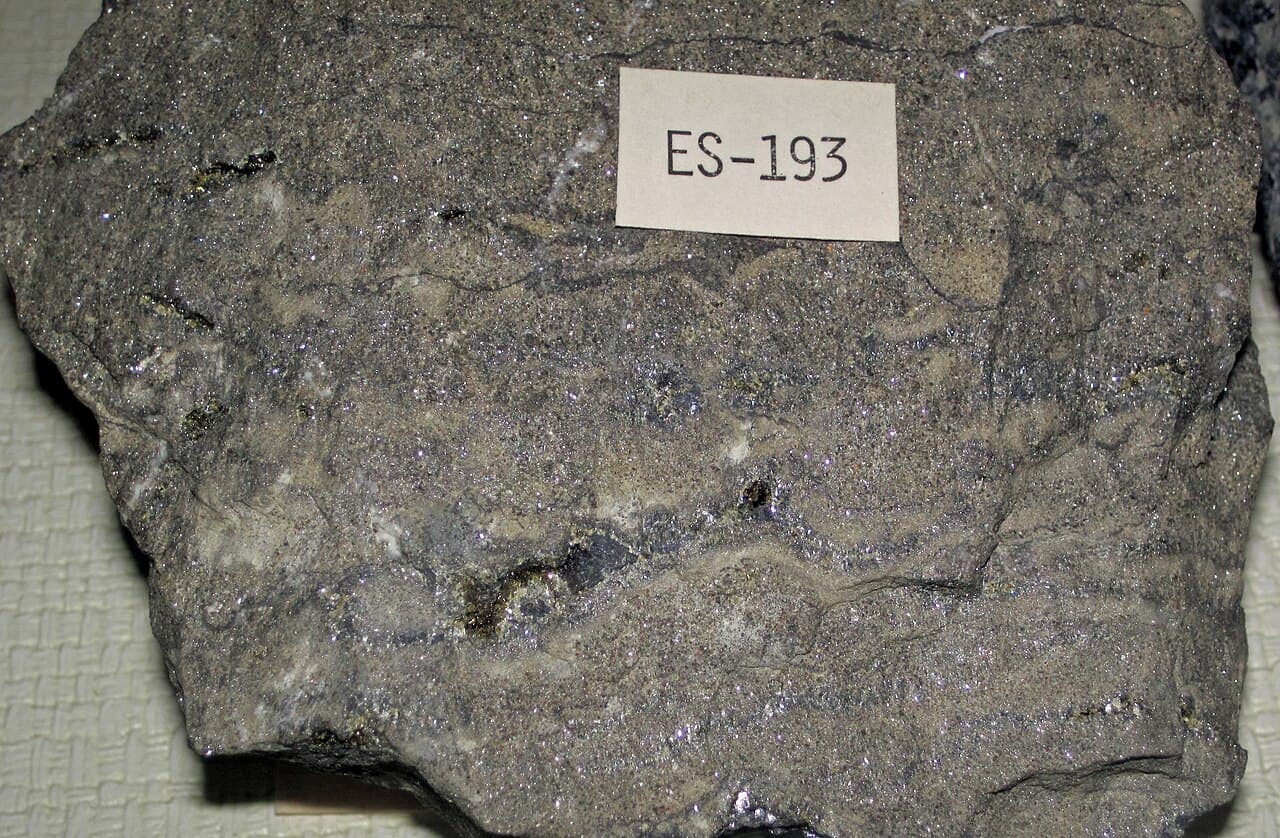
Cut face of pale dolostone with dark brown to honey-coloured sphalerite occupying irregular patches that follow the rock fabric rather than open cavities.
Sulfide replacing carbonate in the Bonneterre Dolomite of southeast Missouri — the district the Mississippi Valley-type class is named after. The USGS model records that sulfides in these systems occur mainly as replacement of carbonate rocks and to a lesser extent as open-space fill; this is the first of those, at hand-specimen scale. Locality: Magmont Mine, New Lead Belt, near Bixby, Missouri, United States, as stated by the source.

James St. John, CC BY 2.0 · CC-BY-2.0 · source · Derivative: Downscaled to 1200 px wide by the Wikimedia thumbnail service; no cropping, no colour or content alteration.

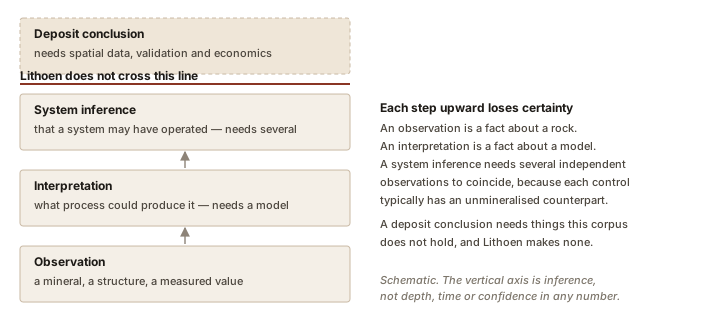
A schematic ladder of four boxes — observation, interpretation, system inference, and a dashed deposit-conclusion box above a solid red line labelled Lithoen does not cross this line — with explanatory text at the right.
SchematicFour levels of statement, and the line Lithoen does not cross. An observation is a fact about a rock; an interpretation is a fact about a model; a system inference needs several independent observations to coincide, because each control typically has an unmineralised counterpart; and a deposit conclusion needs spatial data, validation and an economic framework this corpus does not hold.

Original Lithoen diagram · LITHOEN-ORIGINAL

Record last updated 2026-09-07. Corrections follow the published corrections policy; superseded claims are retained, never silently edited.