
EstablishedTriclinic
The Handbook of Mineralogy records the crystal data of albite as triclinic.
Evidence support: Supported by the cited evidence one source
Evidence: Mineral Data Publishing 2001 Institutional reference
Mineral
The sodium end member of the plagioclase feldspar series, and one of the most abundant minerals of the continental crust.
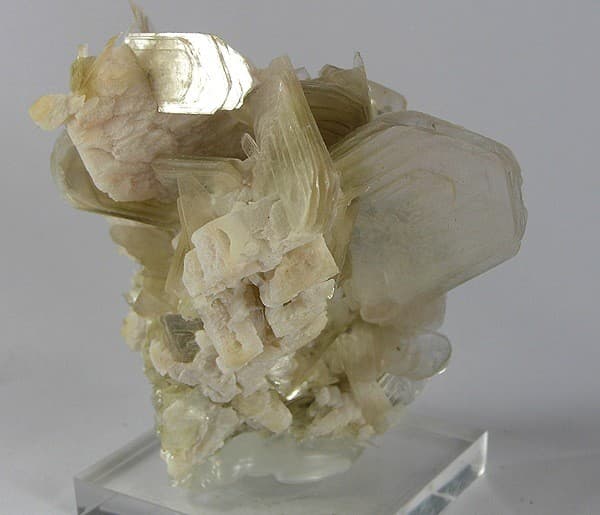
Robert M. Lavinsky, CC BY-SA 3.0 · CC-BY-SA-3.0 · source
3 of 3 claims on this page cite at least one registered source. Counts describe how each statement is known, not how likely it is to be true.
Each claim states how it is known and cites its evidence.
The Handbook of Mineralogy records the crystal data of albite as triclinic.
Evidence support: Supported by the cited evidence one source
Evidence: Mineral Data Publishing 2001 Institutional reference
The Handbook of Mineralogy gives a measured density for albite of 2.60–2.65 g/cm3.
Evidence support: Supported by the cited evidence one source
Evidence: Mineral Data Publishing 2001 Institutional reference
Albite is an accepted mineral species in the IMA List of Minerals, with the CNMNC-approved formula Na(AlSi3O8) and IMA status “grandfathered”.
Evidence support: Supported by the cited evidence one source
Evidence: Commission on New Minerals, Nomenclature and Classification, International Mineralogical Association 2026 Primary authority
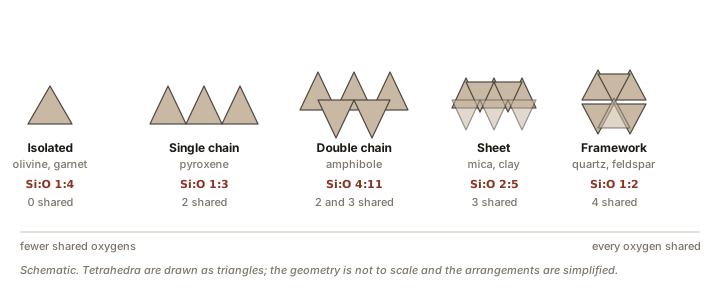
The diagram sets out five structural classes of silicate. Isolated tetrahedra share no oxygens and give Si:O of 1:4, as in olivine and garnet. Single chains share two oxygens per tetrahedron, giving 1:3, as in pyroxene. Double chains share two and three alternately, giving 4:11, as in amphibole. Sheets share three, giving 2:5, as in mica and clay. Frameworks share all four, giving 1:2, as in quartz and feldspar. Moving left to right is a progression of increasing polymerisation.
Original Lithoen diagram · LITHOEN-ORIGINAL
Record last updated 2026-09-06. Corrections follow the published corrections policy; superseded claims are retained, never silently edited.