Skip to content
LITHOEN

Chemical element

Nickel

A trace element that partitions strongly into olivine and into metallic phases — behaviour that links it both to mantle rocks and to Earth’s core.

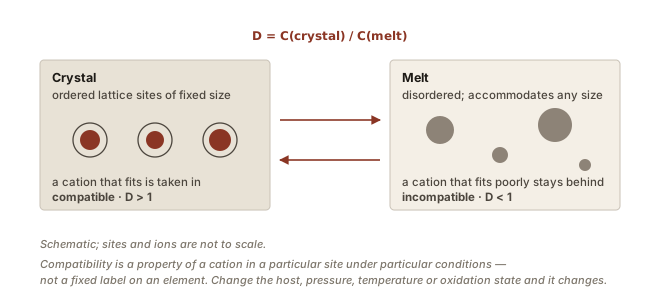
A schematic with a crystal on the left containing sized lattice sites, a melt on the right, arrows exchanging ions between them, and the definition of the partition coefficient D as concentration in crystal divided by concentration in melt.
SchematicWhether an element enters a growing crystal or stays in the melt depends on how well its charge and radius fit the lattice site on offer. The partition coefficient D expresses that as a ratio — but it is a ratio for one cation, one site and one set of conditions, not a property of the element.
Full description of this figure

On the left, a crystal is drawn with three lattice sites of fixed size, each holding a cation. A cation whose charge and radius fit a site is taken into the crystal and is called compatible, with a partition coefficient greater than one. On the right, a melt is drawn as a disordered field able to accommodate cations of any size; a cation that fits the crystal sites poorly is left there and is called incompatible, with a partition coefficient below one. Arrows run in both directions between the two. The partition coefficient D is defined as the concentration in the crystal divided by the concentration in the melt. The figure is labelled schematic and carries the caution that compatibility is a property of a cation in a particular site under particular conditions.

Original Lithoen diagram · LITHOEN-ORIGINAL

Classification

atomic number
28
symbol
Ni
block
d

How this record is known

3
Settled consensus
Cited as the accepted position of the discipline.

3 of 3 claims on this page cite at least one registered source. Counts describe how each statement is known, not how likely it is to be true.

What Lithoen records

Each claim states how it is known and cites its evidence.

Established28 protons

Nickel has atomic number 28: its nucleus contains 28 protons, and that is what makes it nickel.

  • definition basis: Atomic number is definitional: an atom with a different proton count is a different element, whatever else it shares.

Evidence support: Supported by the cited evidence one source

Evidence: Commission on Isotopic Abundances and Atomic Weights (IUPAC) 2024 Primary authority

Established58.6934 u

The standard atomic weight of nickel is 58.6934(4), a single value because its isotopic composition does not vary appreciably between normal materials.

  • definition basis: CIAAW Standard Atomic Weights 2024; the parenthesised digits are the uncertainty in the last figures as published.
  • precision note: A property of the element as found in normal materials, not the mass of any individual atom.

Evidence support: Supported by the cited evidence one source

Evidence: Commission on Isotopic Abundances and Atomic Weights (IUPAC) 2024 Primary authority

In the knowledge graph

Record last updated 2026-09-06. Corrections follow the published corrections policy; superseded claims are retained, never silently edited.