Skip to content
LITHOEN

Chemical element

Lutetium

The last and smallest of the lanthanides, and the end point of the lanthanide contraction.

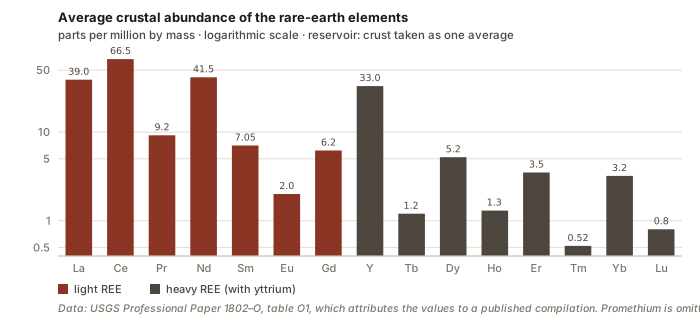
A logarithmic bar chart of average crustal abundance in parts per million for fifteen rare-earth elements, with light rare earths shown in one colour and heavy rare earths including yttrium in another.
Average crustal abundance for the fifteen rare earths, on a logarithmic scale. Cerium, the most abundant, is more common in the crust than copper or lead. What is rare about the rare earths is not the elements but the deposits.
Full description of this figure

Bar chart, logarithmic vertical axis in parts per million by mass. Values: lanthanum 39, cerium 66.5, praseodymium 9.2, neodymium 41.5, samarium 7.05, europium 2.0, gadolinium 6.2, yttrium 33, terbium 1.2, dysprosium 5.2, holmium 1.3, erbium 3.5, thulium 0.52, ytterbium 3.2, lutetium 0.8. Light rare earths are distinguished from heavy rare earths by colour, with yttrium grouped among the heavy ones. The reservoir is the crust taken as a single average; the source does not distinguish continental from oceanic crust. Promethium is omitted because it is extremely rare and unstable in nature.

Original Lithoen diagram · LITHOEN-ORIGINAL

Classification

atomic number
71
symbol
Lu
block
f

How this record is known

4
Settled consensus
Cited as the accepted position of the discipline.

4 of 4 claims on this page cite at least one registered source. Counts describe how each statement is known, not how likely it is to be true.

What Lithoen records

Each claim states how it is known and cites its evidence.

EstablishedProgressive decrease in trivalent ionic radius from La3+ to Lu3+.

Across the lanthanides each added electron enters an inner, incomplete 4f subshell rather than an outer level, so the trivalent ionic radius decreases steadily from lanthanum to lutetium. That systematic contraction is what allows the rare earths to be fractionated from one another in geological environments.

Evidence support: Supported by the cited evidence one source

Evidence: Gosen 2017 Primary authority

Established71 protons

Lutetium has atomic number 71: its nucleus contains 71 protons, and that is what makes it lutetium.

  • definition basis: Atomic number is definitional: an atom with a different proton count is a different element, whatever else it shares.

Evidence support: Supported by the cited evidence one source

Evidence: Commission on Isotopic Abundances and Atomic Weights (IUPAC) 2024 Primary authority

Established174.96669 u

The standard atomic weight of lutetium is 174.96669(5), a single value because its isotopic composition does not vary appreciably between normal materials.

  • definition basis: CIAAW Standard Atomic Weights 2024; the parenthesised digits are the uncertainty in the last figures as published.
  • precision note: A property of the element as found in normal materials, not the mass of any individual atom.

Evidence support: Supported by the cited evidence one source

Evidence: Commission on Isotopic Abundances and Atomic Weights (IUPAC) 2024 Primary authority

Record last updated 2026-09-06. Corrections follow the published corrections policy; superseded claims are retained, never silently edited.