Each claim states how it is known and cites its evidence.
Established58 protons
Cerium has atomic number 58: its nucleus contains 58 protons, and that is what makes it cerium.
- definition basis: Atomic number is definitional: an atom with a different proton count is a different element, whatever else it shares.
Evidence support: Supported by the cited evidence · one source
Evidence: Commission on Isotopic Abundances and Atomic Weights (IUPAC) 2024 · Primary authority
Established140.116 u
The standard atomic weight of cerium is 140.116(1), a single value because its isotopic composition does not vary appreciably between normal materials.
- definition basis: CIAAW Standard Atomic Weights 2024; the parenthesised digits are the uncertainty in the last figures as published.
- precision note: A property of the element as found in normal materials, not the mass of any individual atom.
Evidence support: Supported by the cited evidence · one source
Evidence: Commission on Isotopic Abundances and Atomic Weights (IUPAC) 2024 · Primary authority
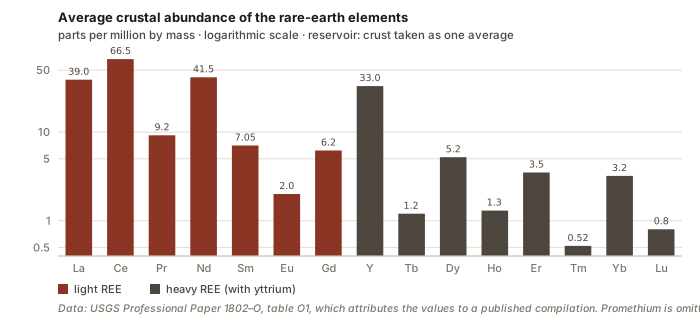
EstablishedThe most abundant rare-earth element in the crust, at about 66.5 ppm on average.
Cerium is the most abundant rare-earth element in Earth’s crust, at an average of 66.5 parts per million — more common there than copper or lead.
- locality: Average crustal abundance.
- method: Compiled values quoted by the USGS report from Lide (2004).
Evidence support: Supported by the cited evidence · one source
Evidence: Gosen 2017 · Primary authority
EstablishedCe
The chemical symbol for cerium is Ce, as listed in the CIAAW table of standard atomic weights.
Evidence support: Supported by the cited evidence · one source
Evidence: Commission on Isotopic Abundances and Atomic Weights (IUPAC) 2024 · Primary authority
EstablishedExcluded from deposit discussion: extremely rare and unstable in nature.
Promethium is excluded from discussions of rare-earth deposits because the element is extremely rare and unstable in nature — the one member of the group for which "rare" is literally true.
Evidence support: Supported by the cited evidence · one source
Evidence: Gosen 2017 · Primary authority
EstablishedCommon in the crust; concentrated deposits are what is rare.
The rare earths are not rare. Cerium is more common in Earth’s crust than copper or lead, and every rare earth except promethium is on average more abundant there than silver, gold or platinum. What is unusual is not the elements but the deposits: concentrated, economic accumulations of them are limited in number and occur in unusual rock types and uncommon minerals.
- locality: Average crustal abundance; the comparison is with copper, lead, silver, gold and platinum.
- precision note: A comparative statement about average crustal abundance, not a concentration datum.
Evidence support: Supported by the cited evidence · one source
Evidence: Gosen 2017 · Primary authority
EstablishedShared 3+ charge and similar radii, with Ce4+ and Eu2+ as redox-controlled exceptions.
The rare earths occur together because they share a trivalent charge and similar ionic radii. Cerium and europium are the exceptions that prove the rule: cerium can be tetravalent and europium divalent, and both consequently separate from the rest under the right conditions.
Evidence support: Supported by the cited evidence · one source
Evidence: Gosen 2017 · Primary authority