The whole planet MINUS the core: mantle plus crust taken together. The distinction from bulk Earth is not pedantry — the core holds most of Earth’s iron and its siderophile elements, so the two compositions are entirely different.
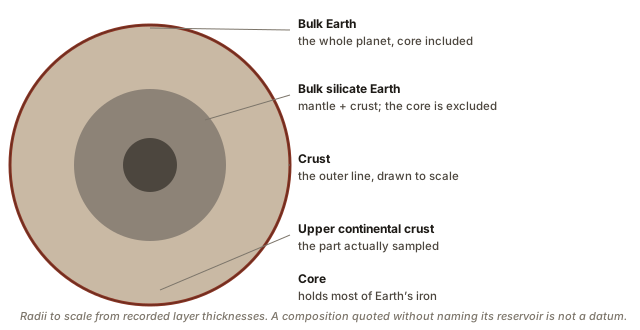
SchematicBulk Earth, bulk silicate Earth, the crust and the upper continental crust are four different volumes, and therefore four different compositions. The core holds most of Earth’s iron, so a figure for one is not a figure for another.Full description of this figure
Concentric shells drawn to scale from Lithoen’s recorded layer thicknesses. The outermost line is the crust. The shell within it is the mantle; mantle and crust together are bulk silicate Earth. Inside those lie the outer and inner core. Bulk Earth is everything, core included. The upper continental crust is only the outermost sampled part of the continental portion of the crust. Because the core holds most of Earth’s iron and its siderophile elements, bulk Earth and bulk silicate Earth are compositions of two different volumes rather than two estimates of one.
Original Lithoen diagram · LITHOEN-ORIGINAL
Classification
scope
silicateEarth
How this record is known
1
Settled consensus
Cited as the accepted position of the discipline.
1 of 1 claims on this page cite at least one registered source. Counts describe how each statement is known, not how likely it is to be true.
What Lithoen records
Each claim states how it is known and cites its evidence.
EstablishedMantle plus crust; the core is excluded.
Bulk silicate Earth means the planet without its core: mantle and crust taken together. Because the core holds most of Earth’s iron and its siderophile elements, bulk silicate Earth and bulk Earth are not two estimates of one thing — they are compositions of two different volumes.
precision note: The exclusion follows from the definition of the reservoir. What its composition actually is, is a separate and model-dependent question.
Evidence support: Supported by the cited evidence· one source