Each claim states how it is known and cites its evidence.
EstablishedThe crust averaged as one body; continental and oceanic are not distinguished.
Average crustal abundance figures are quoted against the crust taken as one averaged body. The compilation they come from does not distinguish continental from oceanic crust, so a figure quoted against “the crust” cannot be transferred to either without further evidence.
- precision note: Recorded because the coarseness of the reservoir is part of what the numbers mean.
Evidence support: Supported by the cited evidence · one source
Evidence: Gosen 2017 · Primary authority
Established66.5 ppm Cerium
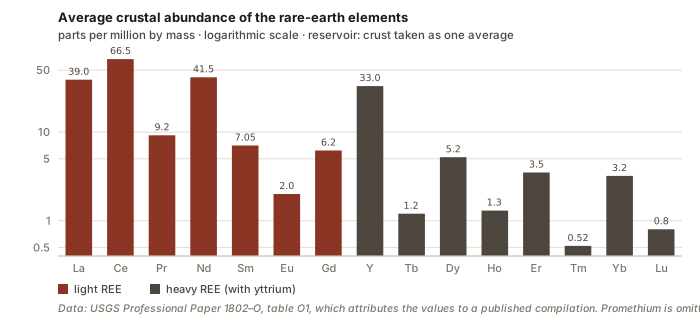
The average crustal abundance of cerium is given as 66.5 parts per million by mass.
- locality: Earth’s crust taken as a single average; the source does not distinguish continental from oceanic crust.
- method: Compiled values, attributed by the report to Lide (2004, p. 17) rather than measured for it.
- precision note: A single averaged figure for a heterogeneous body. It says nothing about the concentration at any particular place, and nothing about whether the element can be recovered anywhere.
Evidence support: Supported by the cited evidence · one source
Evidence: Gosen 2017 · Primary authority
Established39 ppm Lanthanum
The average crustal abundance of lanthanum is given as 39.0 parts per million by mass.
- locality: Earth’s crust taken as a single average; the source does not distinguish continental from oceanic crust.
- method: Compiled values, attributed by the report to Lide (2004, p. 17) rather than measured for it.
- precision note: A single averaged figure for a heterogeneous body. It says nothing about the concentration at any particular place, and nothing about whether the element can be recovered anywhere.
Evidence support: Supported by the cited evidence · one source
Evidence: Gosen 2017 · Primary authority
Established0.8 ppm Lutetium
The average crustal abundance of lutetium is given as 0.8 parts per million by mass.
- locality: Earth’s crust taken as a single average; the source does not distinguish continental from oceanic crust.
- method: Compiled values, attributed by the report to Lide (2004, p. 17) rather than measured for it.
- precision note: A single averaged figure for a heterogeneous body. It says nothing about the concentration at any particular place, and nothing about whether the element can be recovered anywhere.
Evidence support: Supported by the cited evidence · one source
Evidence: Gosen 2017 · Primary authority
Established41.5 ppm Neodymium
The average crustal abundance of neodymium is given as 41.5 parts per million by mass.
- locality: Earth’s crust taken as a single average; the source does not distinguish continental from oceanic crust.
- method: Compiled values, attributed by the report to Lide (2004, p. 17) rather than measured for it.
- precision note: A single averaged figure for a heterogeneous body. It says nothing about the concentration at any particular place, and nothing about whether the element can be recovered anywhere.
Evidence support: Supported by the cited evidence · one source
Evidence: Gosen 2017 · Primary authority
Established33 ppm Yttrium
The average crustal abundance of yttrium is given as 33.0 parts per million by mass.
- locality: Earth’s crust taken as a single average; the source does not distinguish continental from oceanic crust.
- method: Compiled values, attributed by the report to Lide (2004, p. 17) rather than measured for it.
- precision note: A single averaged figure for a heterogeneous body. It says nothing about the concentration at any particular place, and nothing about whether the element can be recovered anywhere.
Evidence support: Supported by the cited evidence · one source
Evidence: Gosen 2017 · Primary authority